
Full Process of Prefabricated House Installation
The full process of prefabricated house installation typically includes five main steps: modular production, transportation and on-site preparation, module assembly, connection and fixation, and subsequent construction.
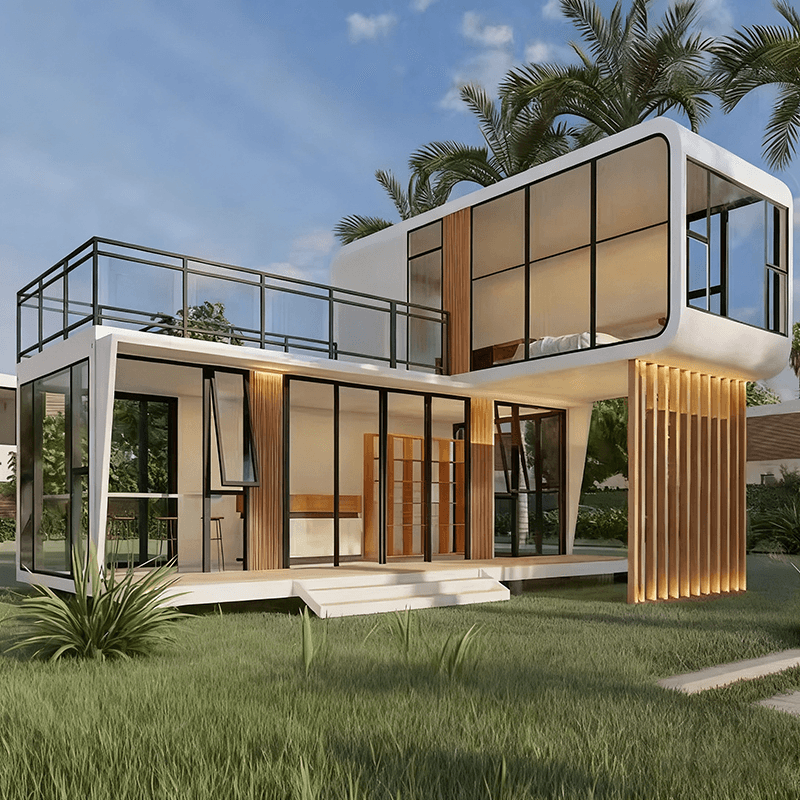
Modular production is the foundational step in prefabricated house installation. The building is broken down into multiple independent modules, such as ceilings, floors, walls, and plumbing and electrical lines. These modules are manufactured in factories through parallel operations and automated production lines. Factory-based production enables strict quality control, enhances production efficiency, and reduces noise and pollution at the construction site.
During the transportation and on-site preparation phase, the prefabricated modules are transported to the construction site. On-site personnel conduct layout positioning to determine the specific installation locations of each module. They also perform preparatory work such as wall and column rebar tying and aluminum formwork sealing, laying the groundwork for subsequent module assembly and connection fixation.
Module assembly is the core step in prefabricated house installation. Large equipment like tower cranes is used to lift the modules to designated positions for assembly, similar to building with blocks. During this process, ensuring precise alignment of each module is crucial, with errors needing to be controlled within millimeters to guarantee the overall stability and aesthetics of the building.
In the connection and fixation phase, after module assembly is complete, cast-in-place connections are made to enhance structural stability. Additionally, procedures such as floor slab bottom rebar tying and plumbing and electrical line reservation and embedding are completed to facilitate subsequent decoration and use.
Subsequent construction includes floor slab concrete pouring and cast-in-place floor leveling. Once these procedures are completed, the installation work for the entire prefabricated house is essentially finished.
Prefabricated house installation offers advantages such as short construction periods, controllable quality, and energy efficiency and environmental protection. However, achieving efficient and high-quality installation requires the support of a comprehensive technical system, production system, and industrial cluster.



