
Prefabricated Container House Foundation
The foundation type of a prefabricated container house should be determined based on geological conditions, load requirements, and budget. Common types include independent foundations, strip foundations, raft foundations, and pile foundations.
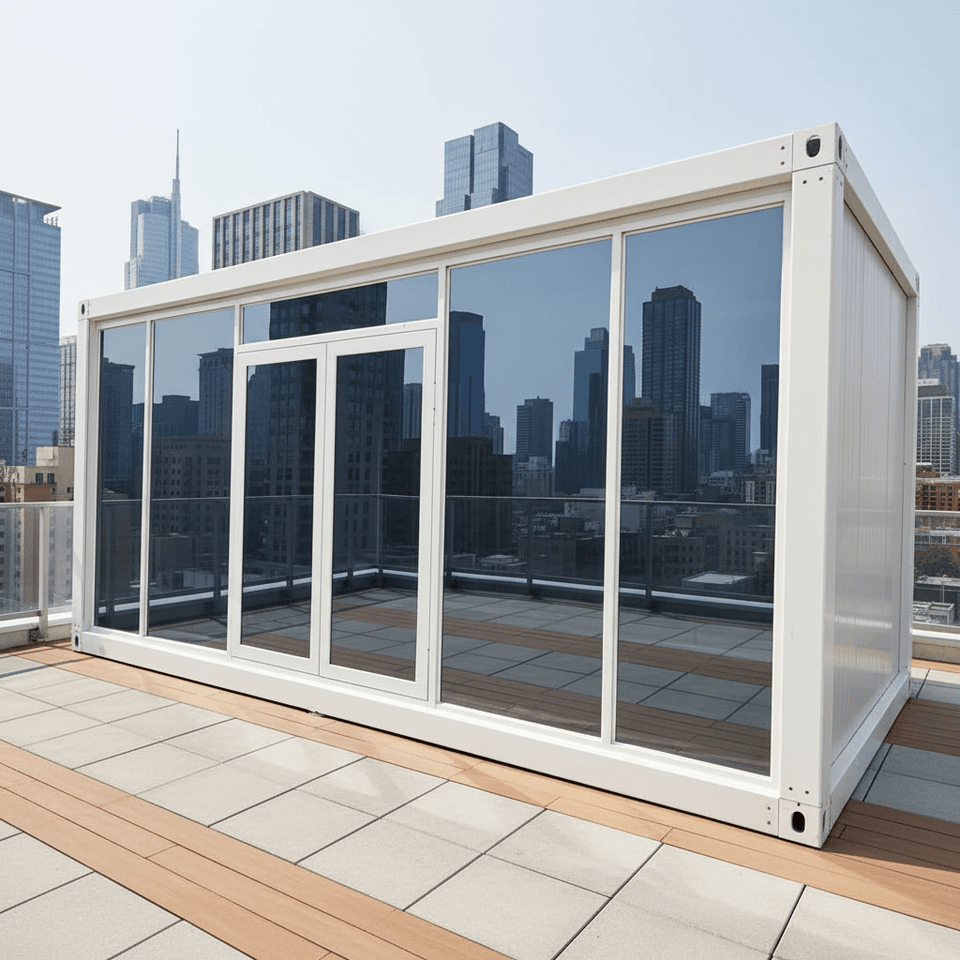
1. Basis for Foundation Type Selection
- Independent Foundation: Suitable for sites with uniform soil quality and strong bearing capacity. It disperses loads through independent support from a single container, with relatively low costs (approximately 200-400 yuan/㎡) and a construction period of 7-10 days. Its advantages include simple structure and low material consumption, but it requires ensuring soil uniformity to avoid local settlement risks.
- Strip Foundation: Designed for soft soil foundations, it transfers loads to deeper soil layers through continuous concrete beams, with costs around 300-500 yuan/㎡ and a construction period of 10-15 days. This type effectively reduces uneven settlement but requires strict control over concrete pouring quality.
- Raft Foundation: Highly integrated, suitable for high-rise container buildings (e.g., above 6 floors). It evenly disperses loads through a large concrete slab, with higher costs (600-800 yuan/㎡) and a construction period of 20-30 days. Its core advantage is strong resistance to settlement, but detailed geological surveys and settlement calculations are required.
- Pile Foundation: Used in areas with silt or high water levels, it transfers loads to deep stable soil layers through piles (e.g., concrete piles, steel pipe piles). Pile lengths typically range from 6-15 meters, with a single pile bearing capacity of 10-30 tons, costs of 800-1200 yuan/㎡, and a construction period of 30-45 days. This type is suitable for complex geological conditions or high load requirements but involves higher construction difficulty and costs.
2. Key Construction Techniques and Regulatory Requirements
- Foundation Treatment: The compaction degree must be ≥95% (standard compaction test) to prevent uneven settlement. The waterproof layer must use SBS modified bitumen membrane or polymer materials with a thickness of ≥3mm to ensure foundation durability.
- Container Connection: Corner bolt strength must reach Grade 8.8 (ISO 898-1), with a horizontal seismic spacing of ≤2m. Welding areas must undergo ultrasonic flaw detection with a 100% pass rate to ensure structural safety.
- Pipeline Embedding: Water supply and drainage pipes should use PPR material, with a temperature resistance of -20℃~95℃ and an embedding depth of ≥0.8m to prevent freezing and cracking. Electrical conduits must be threaded through galvanized steel pipes with a grounding resistance of ≤4Ω (GB 50303 standard) to ensure functionality and safety.
3. Economic and Environmental Advantages
The foundation cost of a prefabricated container house is significantly lower than that of traditional buildings (traditional reinforced concrete buildings cost approximately 2500-4000 yuan/㎡, while container buildings can be controlled within 1500-2500 yuan/㎡), with a construction period shortened by 40%-60%. Additionally, the utilization rate of retired containers exceeds 70%, and CO₂ emissions are reduced by 30% compared to traditional construction methods (data source: World Green Building Council). The modular design supports later-stage additions, with a single-container addition cost of approximately 800-1200 yuan/㎡, eliminating the need for complete demolition and offering both economic and flexible advantages.



