
Prefabricated Cement Prefab House
Prefabricated cement prefab houses are a type of housing constructed using prefabricated reinforced concrete modules as the core, through factory prefabrication and on-site assembly, offering high efficiency, cost-effectiveness, environmental friendliness, and flexibility.
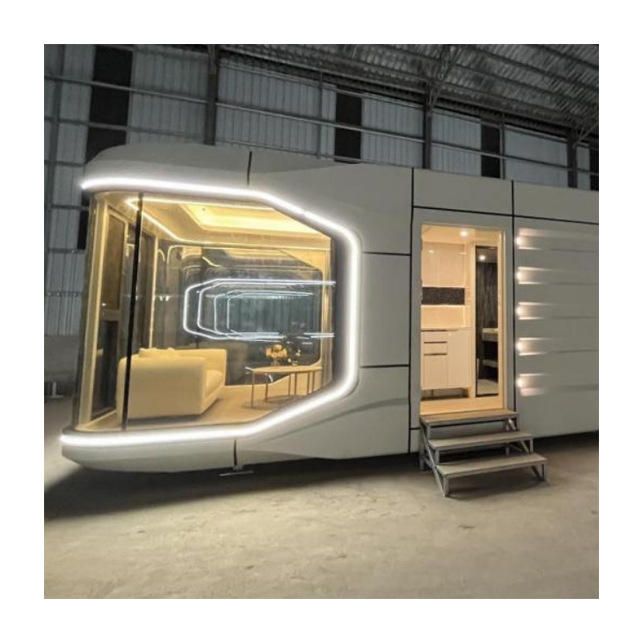
Core Process and Structure
These houses adopt a "factory production + on-site hoisting" model. Core components such as walls, floors, and beams are cast in one piece in the factory using high-precision molds, integrating steel reinforcement skeletons, insulation layers, waterproofing layers, and pre-installed piping systems. Modules are connected using prestressed bolts and welded steel plates to form an overall framework, capable of withstanding wind speeds up to Level 10 and seismic intensity of 7 degrees (equivalent to the destructive force of the Wenchuan earthquake). The technology encompasses prefabricated concrete structures, utilizing C30-C40 grade concrete with embedded Φ8-Φ12 steel reinforcement meshes, achieving a compressive strength of 25-30MPa, 1.5 times that of traditional brick-and-mortar structures.
Advantages and Characteristics
- High Efficiency: A single 30㎡ module can be prefabricated in the factory in just 7 days, with on-site installation taking only 4 hours (with 3 workers and a crane). A 100㎡ house can be fully constructed in just 2 days, significantly faster than the traditional 3-6 month construction period.
- Low Cost: For a 120㎡ self-built rural house, the cost of the main modules is 30% lower than that of traditional brick-and-mortar structures, with total expenses controllable within 200,000 yuan. In a leasing model, the annual rent can be as low as 5,000 yuan per room.
- Green and Environmentally Friendly: Factory production achieves a 95% recycling rate for offcuts, with no dust or sewage emissions on-site. Construction waste is only 10% of that from traditional construction methods. The formaldehyde emission level of materials is ≤0.05mg/m³, well below the national standard of 0.1mg/m³, supporting "immediate occupancy" upon completion.
- Flexible Space: Standard module dimensions are 6m×3m×3m, allowing for free户型 (floor plan) customization through horizontal splicing or vertical stacking (up to 3 floors), suitable for various scenarios such as rural self-built houses and cultural tourism homestays.
Development History
China's prefabricated concrete technology originated in the 1950s, initially used for factory and residential construction. In the 1970s, technical systems such as large-panel structures and box structures were formed. The 1980s saw a stagnation due to cost and quality issues. In the 21st century, it has experienced a resurgence due to production efficiency and environmental advantages, with companies like Vanke developing prefabricated shear wall residential structural systems.
Market Prices
Prices vary by region and brand. For example, the rural villa spliced cement house from the Xiangyun brand in Jining, Shandong, costs 600 yuan per square meter, while the rapid self-built house from the Chengzhixin brand in Zhengzhou, Henan, costs 6,000 yuan per square meter.



