
Prefabricated Assembled Foam House
Prefabricated assembled foam houses are used in both construction sites and rural areas, but they have significant drawbacks, with some cases showing relatively high structural strength for special designs.
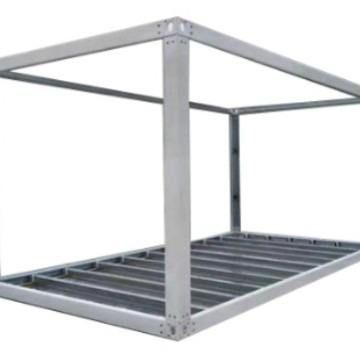
Prefabricated assembled foam houses are widely used at construction sites, with common brands including Wanding and Qingzhigu. The materials used are mostly sandwich panels and color-coated steel, and the styles cover light-steel movable houses, assembled houses, and container houses, with processes involving welding and assembly. Due to their modular design, rapid construction, and mobility, these houses have become the mainstream choice for temporary housing at construction sites.
In rural areas, prefabricated assembled houses built with white foam (EPS material) are gradually emerging, but their drawbacks require special attention:
- Poor fire resistance: EPS material has a low fire rating and does not meet building fire safety regulations. In the event of a fire, the foam will burn rapidly and release toxic gases, becoming a hazard and threatening the safety of occupants.
- Limited wall decoration: The surface of foam walls needs to be covered with a plaster layer for protection. If the plaster layer is damaged, the internal foam is directly exposed, leading to damage to the wall structure. Later, attaching tiles or hanging heavy objects requires special reinforcement, increasing construction costs and difficulty.
- Immature construction techniques: Foam material has low hardness and is prone to deformation during cutting and assembly, resulting in insufficient wall flatness and affecting overall structural stability. Construction relies on professional equipment and experience, making it difficult to promote in rural areas.
- Questionable environmental performance: EPS material may release volatile organic compounds (VOCs) or benzene series substances, which are harmful to health with long-term exposure. Rural areas lack professional testing equipment, making it difficult to assess the environmental performance of materials, and unqualified products can easily cause indoor air pollution.
It should be noted that some cases show that the structural strength of foam houses can surpass traditional perceptions. For example, foam dome houses assembled using special techniques have a structural strength 7.2 times that of ordinary brick walls. These houses disperse stress by optimizing geometric shapes (such as arch structures) and combine high-density foam with reinforcing materials to achieve increased strength. However, the technical threshold and cost are relatively high, and they have not yet become widespread.
In summary, prefabricated assembled foam houses have significant advantages as temporary housing at construction sites, but for self-built houses in rural areas, careful selection is required. Priority should be given to evaluating fire safety, environmental performance, and construction feasibility to avoid safety hazards caused by material defects.



