
Personalized Mobile Toilet
Personalized mobile toilets can be realized through creative design and reasonable assembly, with diverse production methods and clear structural classifications. The following provides an introduction from three aspects: production methods, structural composition, and type classification:
I. Creative Production Methods
Taking the transformation of a water storage tank as an example, the structural construction and functional integration need to be completed step by step. First, use an angle grinder to split the water storage tank vertically into two halves, and take one half as the main frame; install universal wheels at the four corners of the wooden board to form a movable base; use wooden strips and self-tapping screws to fix them on the upper side of the tank to increase the height to accommodate the installation space for sanitary ware. Secondly, cut an entrance on the side of the water storage tank, embed sponge strips to construct the door frame, splice plastic soft boards to form an elevated wall, invert the upper half of the tank onto the top of the wooden strips as the roof, and apply white waterproof paint to enhance aesthetics. For functional modules, it is necessary to drill a hole at the bottom of the tank to install a drain pipe to form a floor drain, drill a hole on the side to connect a plastic bucket as a small water storage device, and connect the water pipe to the bath heater and showerhead; place the toilet and fix the water tank, and connect the drain pipe to the sewage tank; the three-way outlet pipe extends horizontally to the entrance as the inlet pipe for the washbasin, and drill a hole in the door to install a faucet interface. Throughout the process, ensure the sealing of each component to avoid leakage.
II. Standard Structural Composition
The core modules of a mobile toilet include:
- Fecal Treatment System: Includes storage tanks or disposal devices. The dry-packing type directly collects feces, while the water-flushing type needs to be connected to sewage pipes;
- Basic Structure: The floor needs to be slip-resistant and waterproof, and the walls use lightweight materials (such as plastic boards, honeycomb boards) to reduce weight;
- Sanitary Ware: Toilets, washbasins, etc., need to be customized according to the space size, and the water tank capacity needs to meet the needs of a single use;
- Mobile Devices: Single-unit structure toilets are usually equipped with universal wheels or towing devices, while composite-structure toilets may integrate power systems;
- Auxiliary Facilities: The roof needs to be waterproof, and some models are equipped with ventilation systems or lighting equipment.
III. Type Classification Basis
- By Structural Form: Single-unit structures are independent units suitable for single-person use; composite structures are composed of multiple modules that can be expanded into multiple toilet stalls;
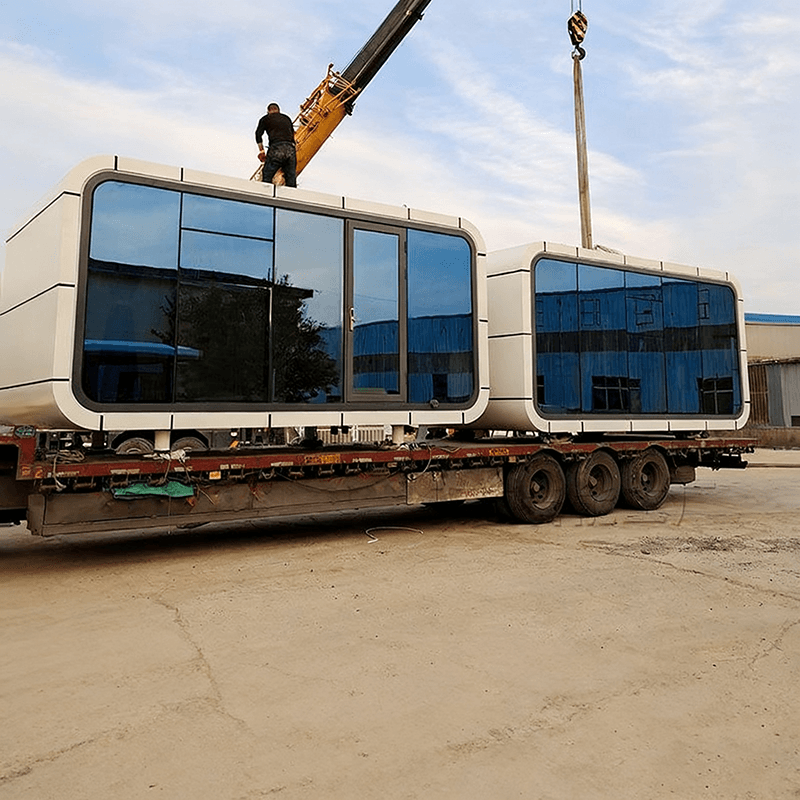
- By Mobility Method: Hoisting types require lifting equipment for transportation, towing types can be connected to vehicles for towing, and powered types have built-in engines for autonomous movement;
- By Sewage Treatment: Water-flushing types require a continuous water supply, non-water-flushing types rely on vacuum suction or dry packing, and circulating water-flushing types reuse water resources through a filtration system.
When producing, the type should be selected according to the usage scenario (such as outdoor activities, emergency rescue), with priority given to ensuring environmental friendliness and convenience.



