
Mobile Toilet Production Schematic
There is currently no publicly available standard production schematic for mobile toilets, but their core structural and functional design principles can be explained. Mobile toilets typically consist of modules such as fecal wastewater storage tanks (or disposal units), floor panels, sanitary fixtures, walls, washing equipment, water tanks, roofs, and mobile units. The core of their design lies in modular integration, environmentally friendly treatment, and convenient mobility. The specific principles are as follows:
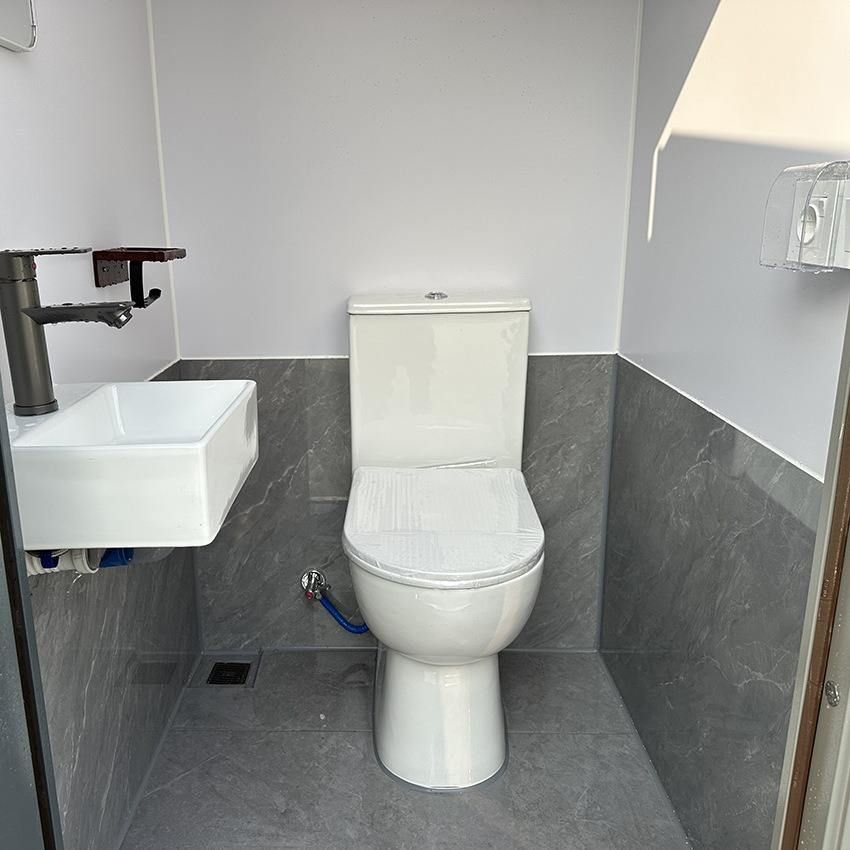
1. Structural Modular Design Principles
Mobile toilets adopt a lightweight box structure, with each functional module independently designed and then integrated for installation. For example, the toilet and the sewage storage unit are connected via sealed pipes to form an independent excretory system; the walls and roof are made of detachable panels (such as metal, fiberglass-reinforced plastic, or eco-friendly plastics), which are fixed together using bolts or clips, eliminating the need for traditional civil engineering; the floor panels need to be slip-resistant and waterproof, typically made of high-strength composite materials, and connected to the bottom of the box via shock absorbers to ensure stability during movement. The mobile unit (such as a wheeled chassis or towing structure) is then fixed to the bottom of the box via welding or bolts, enabling overall towing or lifting.
2. Excreta Treatment Principles
Mobile toilets can be classified into storage-type and disposal-type based on their treatment methods:
- Storage-type: Excreta directly enters a sealed sewage storage tank through the toilet. The tank must be leak-proof and corrosion-resistant, with a reserved sewage outlet for regular cleaning. This design is suitable for short-term use scenarios (such as exhibitions and construction sites) and requires regular pumping by sewage suction trucks.
- Disposal-type: Built-in small-scale treatment units (such as biological degradation, chemical disinfection, or physical filtration systems) convert excreta into harmless substances or compliant wastewater after treatment. For example, biological degradation toilets use added microbial strains to decompose organic matter, reducing sewage volume; chemical disinfection toilets use disinfectants to suppress odors and the growth of pathogens.
3. Ventilation and Cleaning System Principles
To ensure hygiene during use, mobile toilets must be equipped with forced ventilation units (such as exhaust fans or air vents) and cleaning equipment. The ventilation system expels odors from the box using negative pressure principles, with some high-end models also integrating air purification modules; the cleaning equipment includes high-pressure water guns, disinfectant sprayers, or automatic flushing systems to ensure the cleanliness of the toilet and floor. Additionally, the roof design must consider waterproofing and lighting, typically adopting a sloped structure with transparent panels to balance drainage and illumination needs.
4. Mobility and Installation Principles
The convenience of mobile toilets lies in their rapid deployment and disassembly. Their box structure enables module interchangeability through standardized design. During installation, only the connection points of each component need to be fixed (such as bolting the columns to the floor panels and clipping the walls to the roof); during movement, the entire unit can be transferred using a wheeled chassis or towing device, with some models also supporting folding designs to reduce transportation space.



