
How to Load Mobile Toilets onto Vehicles
Loading mobile toilets onto vehicles requires following two main steps: preparation before transportation and loading and securing. Here are the specific operations:
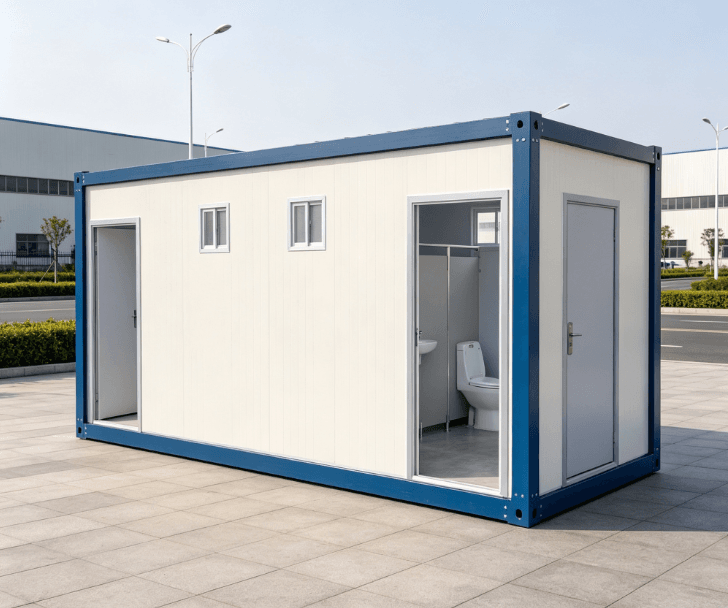
Preparation before transportation is the foundation for ensuring smooth loading. First, conduct on-site inspection and planning, focusing on evaluating the ground flatness, load-bearing capacity, and spatial openness of the loading site to avoid obstructing the operation of loading equipment due to soft ground or narrow space. At the same time, determine the quantity, model, and layout of mobile toilets according to transportation needs, such as independent transportation of a single unit or combined transportation of multiple units. Secondly, conduct a comprehensive inspection of each mobile toilet to be transported, including whether the box structure is intact, whether the door locks can open and close normally, whether the internal sanitary fixtures (such as toilets and sinks) are firmly fixed, whether the water tank has good sealing performance, and whether the ventilation system (such as exhaust fans and air vents) operates normally, ensuring that the equipment has no damage or functional defects. Finally, select an appropriate transportation vehicle based on the dimensions (such as length, width, and height) and weight (usually 1-5 tons) of the mobile toilets, as well as the road conditions at the destination (such as urban roads, rural roads, or mountain roads). Generally, flatbed trucks or low-bed trailers are preferred. The former is convenient for direct loading, while the latter can lower the center of gravity and improve transportation stability. At the same time, plan the transportation route in advance to avoid sections with height limits, width limits, sharp bends, or potholes, reducing transportation risks.
Loading and securing are the core links to ensure transportation safety. When loading, use mechanical equipment such as forklifts or cranes. During operation, ensure that the contact points between the equipment and the mobile toilets are evenly stressed to avoid box deformation or damage due to excessive local pressure. For example, the forklift should insert its forks into the special slots or reinforced crossbeams at the bottom of the mobile toilet, and the crane should fix the top or frame structure of the box through special lifting straps or hooks. During the loading process, operate slowly and steadily to prevent the mobile toilet from shaking or colliding with the transportation vehicle. After loading is completed, use professional securing straps, ropes, or chains to firmly connect the mobile toilet to the vehicle floor. The securing points should be selected from the frame structure or reinforced parts of the box to avoid directly securing to easily damaged components (such as doors, windows, and sanitary fixtures). At the same time, adopt a cross-securing or multi-point securing method to ensure that the mobile toilet will not slide, shift, or overturn during transportation due to bumps, turns, or emergency braking. After securing is completed, check the tightness of the securing straps again to ensure there is no risk of loosening or falling off.



