
Mobile Public Toilet
A mobile public toilet is a facility that can be moved as a whole and provides toilet services to the public. It is suitable for various places and comes in multiple types with distinct features.
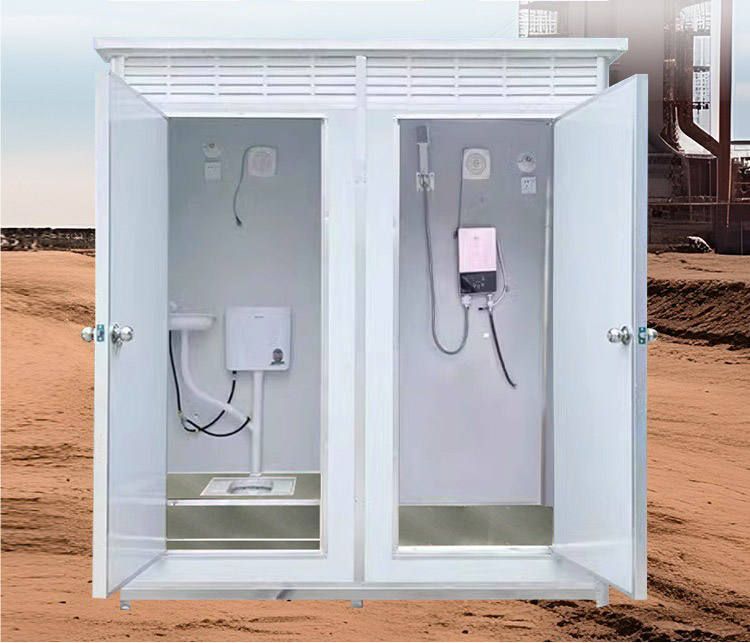
Suitable Locations: Mobile public toilets are suitable for stations, docks, tourist attractions, villa areas, newly built residential communities, large construction sites, squares, densely populated public places, and bustling commercial streets. These locations often require flexible and convenient toilet facilities due to factors such as high foot traffic, high costs of constructing fixed toilets, or space limitations. Mobile public toilets precisely meet this demand.
Composition and Structure: They are generally composed of fecal sewage storage tanks (or fecal sewage treatment devices), floor slabs, sanitary ware, walls, washing equipment, water tanks, roofs, and mobile devices. Mobile toilets produced by different manufacturers may vary in specific configurations. For example, some are fully equipped with internal fecal collection systems, hand-washing basins, smart mirrors, and breathing lights; some two-squat-position toilets can be customized in size, with basic and luxury models available. The luxury models have larger overall dimensions and feature a public hand-washing basin in front; others, like the warm-toned Apple Pod mobile toilets, have two squat positions each for men and women, equipped with urinals, and a public hand-washing area in front with separate zones for men and women.
Development History and Types: Initially, mobile toilets were made of materials like wood, with simple structures and functions, and were prone to absorbing odors. Later, they gradually evolved to use materials such as fiberglass-reinforced plastic and polyethylene. According to structural forms, they can be divided into single-structure mobile toilets and composite-structure mobile toilets; based on mobility methods, they can be classified as lifting and handling mobile toilets, powered and towed mobile toilets; and according to sewage treatment methods, they can be categorized as water-flush and waterless suction mobile toilets, circulating water-flush mobile toilets, and dry-packing mobile toilets.
Features and Advantages: They can be conveniently transported to any location where toilets need to be installed and can be used repeatedly. They offer advantages such as mobility, modularity, and ease of transportation. After being fully manufactured in the factory, they can be used immediately upon purchase. Some types only require water and electricity connections on-site and can be completed within 7-10 days, significantly saving construction time and costs.



