
Mobile House Container with Air Conditioner
The selection of air conditioners for mobile house containers should be tailored to specific scenarios, with the core focus on matching the characteristics of the house with the performance of the air conditioner. In different scenarios, the structure and usage requirements of container mobile houses vary significantly, leading to different demands for the cooling capacity, air delivery capacity, and installation form of air conditioners, necessitating targeted equipment selection.
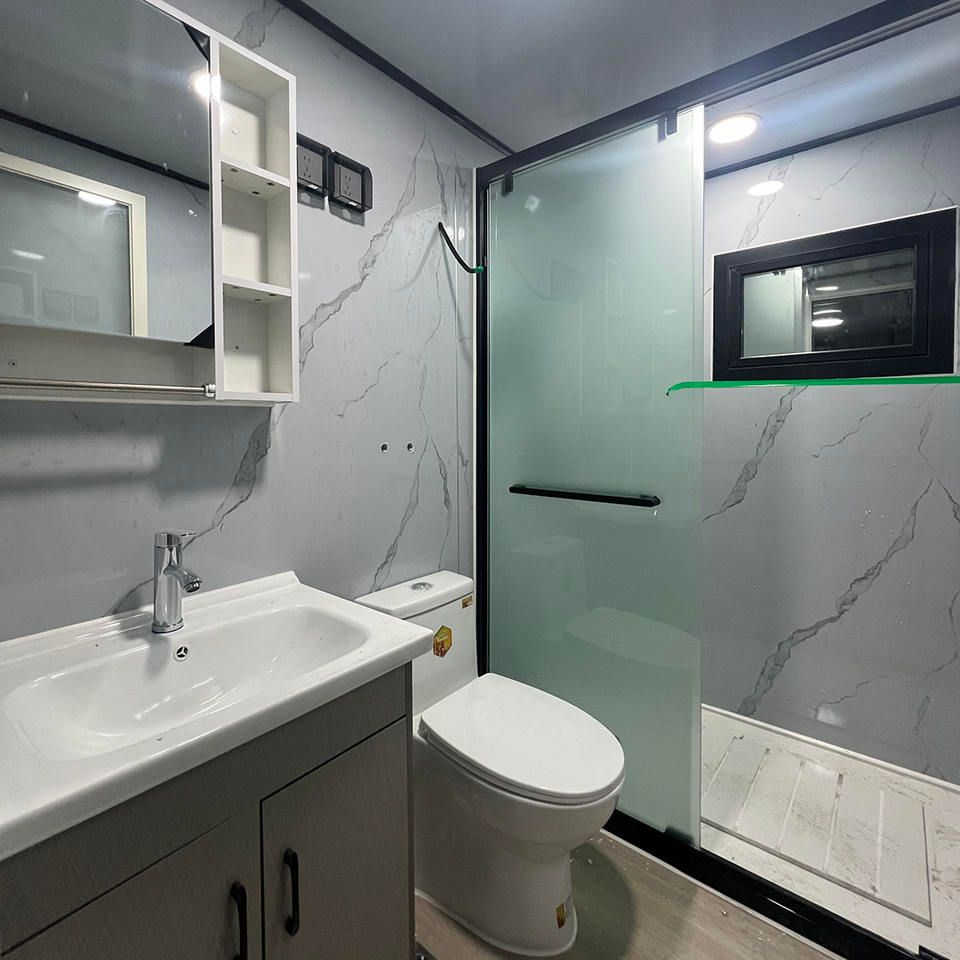
For energy storage and industrial container houses, dedicated industrial air conditioners are required. These houses are typically used in scenarios such as energy storage containers and mobile energy storage power stations, where internal equipment generates a large amount of heat and needs to be isolated from the external environment. Dedicated industrial air conditioners adopt a design with high air volume and small enthalpy difference, achieving a sensible heat ratio of over 85%, which can quickly remove equipment heat and avoid waste of cooling capacity. They are equipped with fully enclosed scroll compressors, EC stepless speed-regulating fans, and corrugated aluminum fin heat exchangers, ensuring stable operation and high energy efficiency. They feature dual temperature control for cooling and heating, high-humidity dehumidification, and year-round cooling functions, adapting to complex environments. The installation forms are flexible, including floor-standing, wall-mounted, and ceiling-mounted options, meeting different spatial layout requirements and widely applied in scenarios such as oil exploration, railway communication base stations, and offshore platforms.
For commercial temporary spaces (such as pop-up stores and exhibition booths), a combination of quick-assembly container houses and air conditioning systems should be selected. These scenarios have high requirements for the aesthetic appearance, wind and earthquake resistance, and flexibility of air conditioning layout of the houses. For example, the quick-assembly container houses provided by Suzhou Dengyue Color Steel Plate adopt a space capsule patent structure, combining aesthetics with practicality, and achieving a wind and earthquake resistance level of up to 8. The air conditioning system needs to support custom appearance design and can be seamlessly integrated with the container house structure to ensure overall coordination. This combination can meet commercial display needs while improving space utilization through flexible layout.
Ordinary household air conditioners are not suitable for most container mobile houses. Taking tent exhibitions as an example, their temporary structures lack wall insulation layers, and the metal tent roof loses cooling capacity quickly under direct sunlight. Additionally, large spaces have high requirements for air delivery distance and air pressure. Ordinary household air conditioners, due to insufficient cooling capacity and weak air delivery capacity, are difficult to meet the demands even when connected in parallel, often leading to poor cooling effects and high energy consumption. Therefore, when selecting air conditioners, priority should be given to matching the equipment performance with the characteristics of the house to avoid affecting usage effectiveness due to improper matching.



