
Mobile Container House Welding
The welding of mobile container houses mainly involves the manufacturing of welded boxes (large-corrugated residential containers), with core aspects including welding processes, material selection, structural characteristics, and quality control.
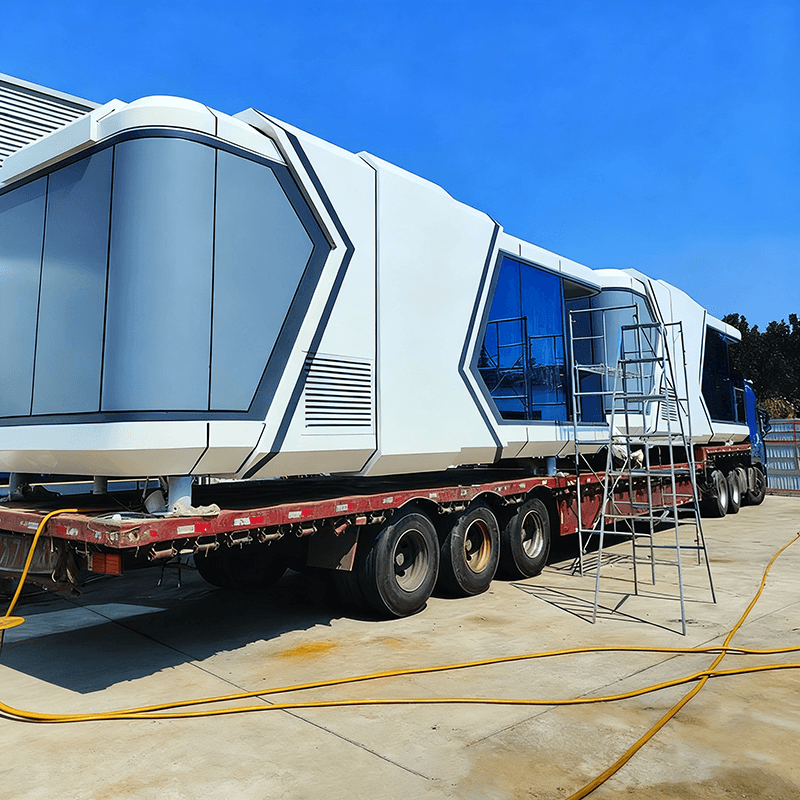
Welding Process Welded boxes employ a full-welding process, ensuring structural airtightness and strength through continuous welding. This process makes the boxes robust and suitable for turnover use on construction sites. For example, the welded boxes produced by Beijing Changlezhijia Activity House Co., Ltd. achieve structural firmness through full-welding technology and can be directly transported via integral lifting. During welding, it is necessary to control weld quality to avoid defects such as air holes and cracks, ensuring compliance with waterproof and fireproof performance standards.
Material Selection Steel containers are the mainstream choice due to their high strength, good weldability, and low cost. For instance, the welded boxes of Suzhou Hengxiangda Integrated Housing Co., Ltd. use steel to form a sturdy framework through welding. Some high-end products opt for galvanized steel or anti-corrosion coatings to enhance weather resistance and extend service life to 20 years. Although aluminum alloy containers are lightweight, their poor weldability makes them unsuitable for manufacturing welded boxes.
Structural Characteristics Welded boxes feature a fixed structure, integrating top panels, side panels, bottom panels, and frameworks through welding. For example, the products of Zhongyu Integrated Housing Technology (Suzhou) Co., Ltd. adopt a corrugated panel design to enhance structural rigidity. The box dimensions adhere to international standards (e.g., 6058mm×2438mm×2896mm), facilitating transportation and stacking. Although modular design is not a strong point of welded boxes, some products simplify on-site assembly through standardized components.
Quality Control Welded boxes must meet Class A fire resistance standards, with side panels filled with soundproof and thermal insulation materials. For example, the products of Beijing Falilai Mobile Board House Co., Ltd. use color-steel sandwich panels, combining welded frameworks with panels to achieve fireproof, waterproof, and thermal insulation functions. After welding, non-destructive testing (e.g., X-ray inspection) is required to ensure weld strength complies with ISO standards, preventing cracking during transportation or use.
Application Scenarios and Advantages Welded boxes are widely used in scenarios such as worker dormitories and temporary warehouses due to their low cost and sturdy structure. Their integral lifting feature reduces on-site construction time, making them suitable for projects with tight schedules. Compared to packing boxes, welded boxes offer lower flexibility in disassembly and assembly but have lower single-use costs, making them more suitable for budget-constrained projects that do not require frequent relocation.



