
Mobile Container House Base
The mobile container house base uses containers as the core carrier. Through modular design, factory prefabrication, and rapid on-site assembly, it constructs a movable, reusable, and multifunctional temporary or permanent building base, widely applied in engineering camps, commercial operations, cultural and tourism accommodations, emergency support, and other scenarios.
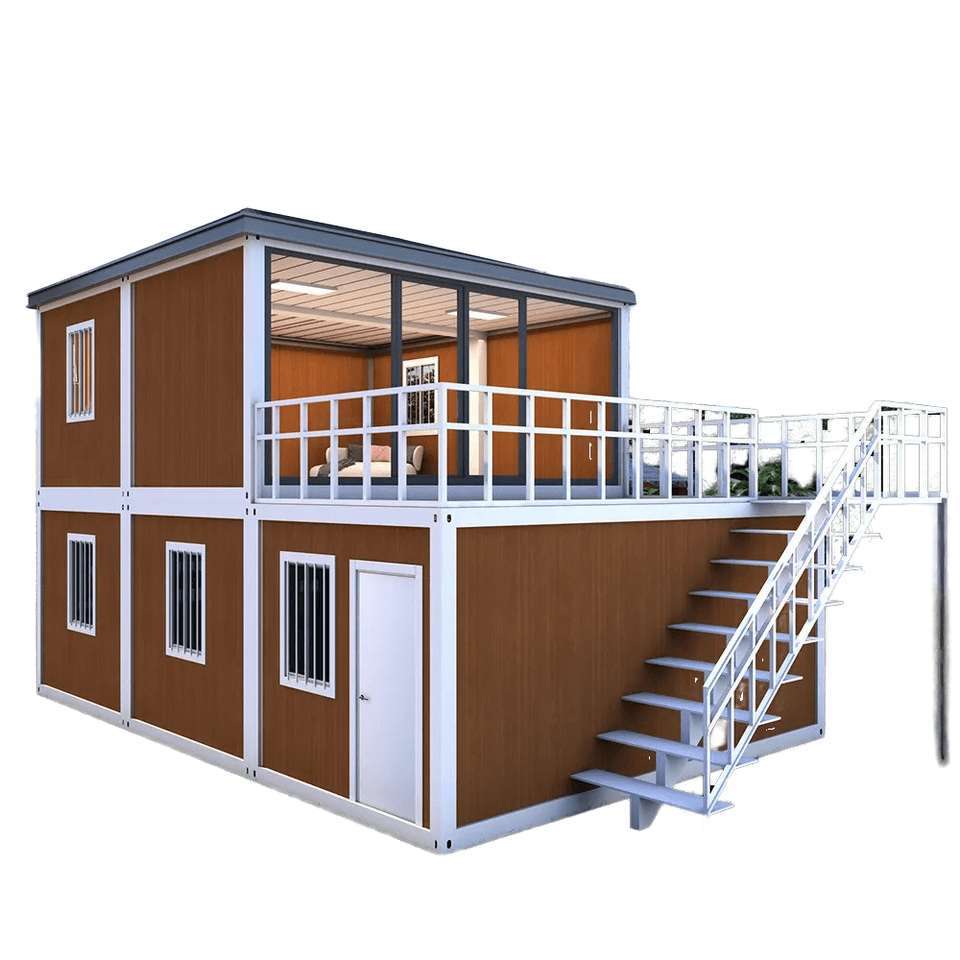
1. Structural Types and Functional Adaptations
Mobile container houses can be divided into five categories based on structure and use:
- Container-style office houses: Modified from standard containers, commonly available in 20-foot and 40-foot sizes. They can be used individually or combined, with a sturdy structure and convenient transportation, suitable for project departments and construction site command centers.
- Foldable office houses: Designed with a folding structure, they compress in volume during transportation and can be quickly expanded on-site, with the expansion time for a single unit controlled within 30 minutes, suitable for exploration teams and temporary command posts with frequent relocation needs.
- Assembled office houses: Composed of light steel keels and color steel plates, they are modularly assembled on-site and can be flexibly expanded according to the number of people and functional divisions, commonly seen in temporary offices in industrial parks and event planning sites.
- Expandable office houses: Additional side or end expansion modules are added to the container, increasing the usable area by 30%-50% after expansion, suitable for long-term on-site offices with higher space comfort requirements.
- Customized creative office houses: Incorporating elements such as glass curtain walls, wood grain finishes, and irregular structures, they are used for brand displays, cultural and creative parks, high-end temporary offices, and other scenarios, balancing functionality and visual expression.
2. Core Performance and Safety Standards
Structural stability is the core safety indicator for container houses. For example, the all-steel frame container mobile houses from Suzhou Zhongnan Steel Structure Co., Ltd. have passed third-party testing to meet a 12-level wind resistance standard and an 8-degree earthquake resistance intensity, with a frame deformation rate of only 0.2%, complying with the GB50009-2012 Building Structural Load Code. In contrast, non-standard off-brand products are prone to frame deformation and wall cracking in 8-level winds, with rework and repair costs reaching 60% of the single-unit product's manufacturing cost, highlighting the safety value of compliant products.
3. Economic and Environmental Advantages
Mobile container houses support multiple disassemblies and reuses, with leading compliant products averaging over 8 disassembly and reuse cycles, reducing construction waste emissions by about 90% compared to traditional fixed temporary buildings and achieving higher resource utilization. For example, the foldable containers from Suzhou Zhongnan have a volume of only 1/5 of their expanded state when folded, reducing transportation costs by 40% compared to non-foldable products and increasing warehouse space utilization by 60%, suitable for emergency rescue and short-term turnover scenarios.
4. Application Scenarios and Market Trends
Mobile container houses have expanded from single engineering scenarios to diverse fields. For example, container commercial streets, with advantages such as lightweight construction, high-value appearance, and rapid deployment, have become core solutions for business upgrades in cultural and tourism towns and creative industrial parks; modular data centers, through factory prefabrication and on-site assembly, have shortened construction cycles by nearly half, meeting the explosive demand for global AI computing infrastructure.



