
Integrated Container Mobile House
An integrated container mobile house is a mobile building form based on standard containers, achieving rapid assembly, disassembly, and relocation through modular design. It features reusability, low-carbon environmental protection, and adaptability to multiple scenarios, and is widely used in engineering camps, cultural and tourism accommodations, emergency support, and other fields.
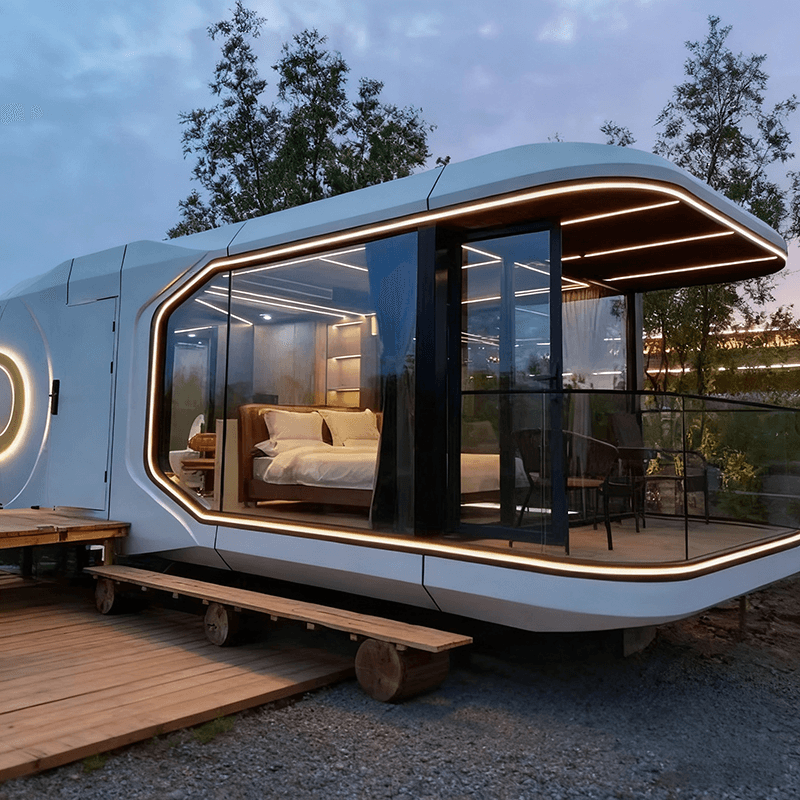
Core Structure and Performance Characteristics
Modular Design
Using standard containers as basic units, different functional spaces (such as dormitories, offices, and commercial stores) are formed through splicing, stacking, or expansion. For example, the packing boxes from Suzhou Zhongnan use a full-steel structural frame with a wind resistance rating of Level 12 and an earthquake resistance rating of Level 8. The frame deformation rate is only 0.18%, far exceeding the industry's qualified threshold of 0.3%, ensuring structural stability under extreme working conditions.Rapid Assembly, Disassembly, and Relocation
The use of a welding-free quick assembly process reduces assembly and disassembly losses. For instance, the quick-assembly boxes from Suzhou Zhongnan can be installed in just 2 hours per set, supporting on-demand splicing and combination, and 10 standard dormitory sets can be built within 1 day. The folding packing boxes compress the transportation volume through a folding structure and can be quickly unfolded on-site, balancing logistics efficiency and space utilization.Low-Carbon and Reusable Attributes
Supporting multiple assemblies and disassemblies for reuse, the average number of assembly and disassembly times for compliant leading products can reach more than 8 times, and the construction waste emissions are reduced by about 90% compared to traditional fixed temporary buildings. For example, the Baotou Camp Container House Company optimizes the steel structure's anti-corrosion and load-bearing design, enabling the container body to remain stable when stacked three layers high, with the assembly and disassembly loss rate controlled within 5%.
Application Scenarios and Adaptability
Engineering Camps
Rapid delivery is required to adapt to short-term project cycles. For example, in the Qatar World Cup Fan Village project, the Suzhou Zhongnan team completed the delivery of 1,000 accommodation modules and supporting facilities within 3 months, shortening the industry's average construction period by 40%.Cultural, Tourism, and Commercial Scenarios
Rely on personalized customization and spatial flexibility. The folding packing boxes from Hebei Xinheng are customized on the exterior facade and internally transformed to adapt to scenarios such as Middle Eastern oil camps and tourist accommodations in high-cold regions of Russia, featuring wind and sand resistance, high-temperature resistance, or thermal insulation.Emergency Support
Rapid response and compliance qualifications are required. Products from leading manufacturers have passed international certifications such as CE and ASTM, meeting the needs of cross-border engineering projects. For example, in emergency rescue and relocation, office and dormitory areas can be quickly built.
Industry Trends and Purchase Recommendations
Low-Carbonization throughout the Entire Life Cycle
The industry is gradually phasing out single-use products, and compliant manufacturers' products have higher resource utilization rates, aligning with green construction policy guidelines.Enhanced Cross-Scenario Versatility
High-quality products cover multiple fields such as engineering, commerce, cultural tourism, and emergency response through modular splicing and functional transformation, reducing the risk of selection errors.Key Dimensions for Purchase
- Process Performance: Prioritize products with welding-free quick assembly processes, low assembly and disassembly losses, and high structural stability;
- Compliance and Services: Verify production qualifications, domestic and foreign certifications, and after-sales implementation capabilities;
- Return on Investment: Evaluate the reuse cost and operational efficiency throughout the entire life cycle.



