
How to Move the Ground of Environmental Toilet
The method of moving the ground of an environmental toilet mainly relies on its movable design, which can be achieved through a wheeled chassis, lifting interfaces, or forklift handling. Specific operations should be carried out in accordance with the equipment type and ground conditions.
1. Wheeled Chassis Design
The wheeled chassis of an environmental toilet is its most basic means of movement. It is typically equipped with heavy-duty swivel or directional wheels at the bottom, with a wheel diameter range of 200-400mm, and the material is mostly polyurethane or rubber. These wheels have two core functions: first, they absorb vibrations through elastic materials to reduce bumps during movement; second, they support the overall weight of the toilet (usually capable of bearing 2-5 tons) through a high-strength structure (such as a dual-bearing design).
Operations should be carried out according to different scenarios during movement:
- Short-distance manual movement: Suitable for hardened pavements or flat grasslands. Before operation, lock the rear wheels (to prevent sliding), ensure the front wheels turn flexibly, and control the pushing speed within 5km/h to avoid side-overturning due to inertia.
- Mechanical traction movement: Some high-end models are equipped with traction hooks that can be connected to small forklifts, tractors, or pickup trucks. When towing, maintain a constant speed (recommended ≤10km/h) and avoid sharp turns to prevent wheel jamming or structural deformation.
2. Lifting and Forklift Interface Design
For long-distance or cross-site transfers, environmental toilets usually reserve standardized handling interfaces:
- Forklift handling: Slots with a height of 140-200mm are set at the bottom, matching the width of standard forklift tines. During operation, ensure the tines are fully inserted into the slots, the center of gravity is near the centerline of the forklift, and the lifting speed does not exceed 0.3m/s to prevent the toilet from sliding due to tilting.
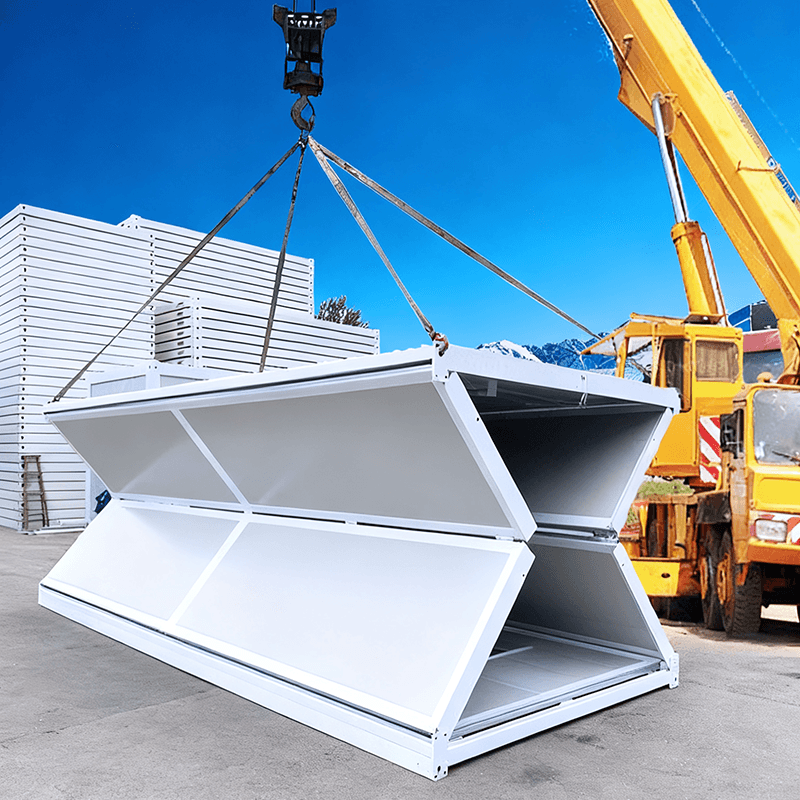
- Lifting handling: Lifting rings (usually with a bearing capacity ≥3 tons) are installed on the top or side, and professional lifting straps or steel cables should be used for fixation. During lifting, maintain a level position (tilt angle ≤5°) to avoid damaging the toilet structure due to excessive local stress.
3. Basic Condition Inspection Before Movement
Regardless of the method used, the ground conditions must be confirmed in advance:
- Bearing capacity requirements: The ground must be able to bear the self-weight of the toilet and the weight of the moving equipment (generally ≥5 tons/square meter). For soft ground, steel plates or roadbed plates should be laid.
- Path clearance: Remove obstacles such as stones and potholes to prevent wheel jamming or scratching during lifting.
- Structural fixation: Before movement, close all doors and windows and fix internal equipment (such as water tanks and fecal storage tanks) to prevent damage due to shaking.
Through standardized operations, environmental toilets can achieve safe and efficient ground movement, meeting the flexible deployment needs of temporary events, emergency rescue, and other scenarios.



