
Mobile Toilets for High-rise Construction Sites
Mobile toilets for high-rise construction sites are designed as portable and rapidly deployable sanitation facilities to meet the hygiene needs of construction sites. They feature high flexibility, controllable costs, and environmental adaptability. Their core function is to address the issues of long construction periods, high costs, and the inability to relocate with the progress of traditional fixed toilets. The specific classifications and characteristics are as follows:
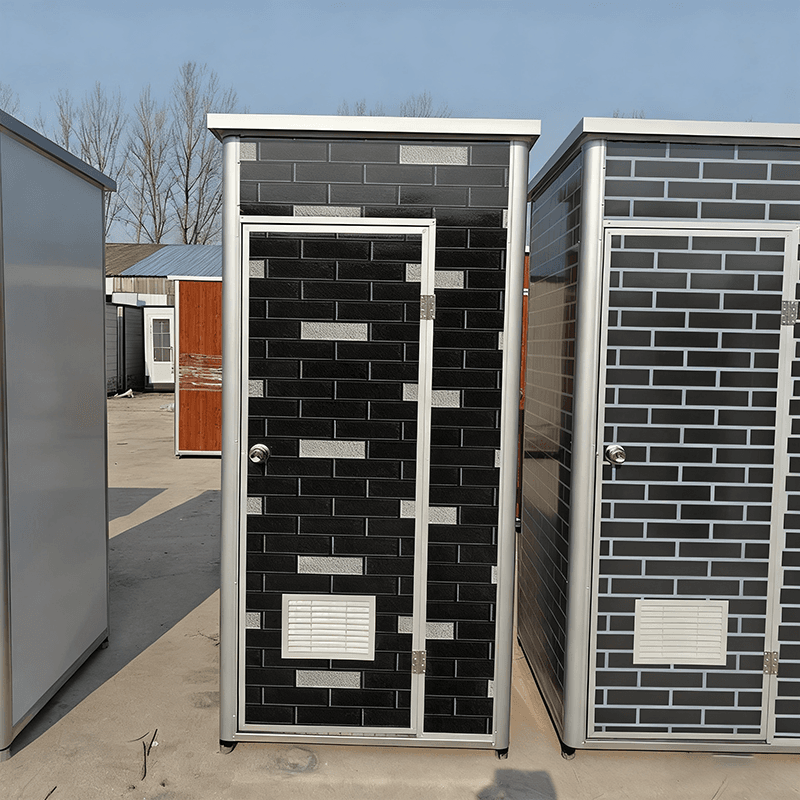
I. Structural Forms and Applicable Scenarios
- Integrated Mobile Toilets
These are manufactured using an integrated forming process, resulting in a high-strength and well-sealed main structure. However, they require professional equipment for transportation and hoisting. For example, the 'Public Restroom Metal Carved Mobile Toilet' produced by Guangdong Yizhou Traffic Industry Co., Ltd. features metal carved panels for the walls and seamless stainless steel interior, offering corrosion and rust resistance, suitable for long-term construction sites with high aesthetic requirements. - Modular Mobile Toilets
These use a steel frame structure covered with sandwich panels (such as rock wool, color steel, or foam sandwich panels). They can be disassembled for transportation and assembled on-site, providing high flexibility. For instance, the 'Single-蹲位 Public Restroom' (dimensions 1.1×1.1×2.3m) by Sichuan Baishixin Environmental Protection Technology Co., Ltd. can quickly respond to emergency needs; the 'Smart Station' by Hengyue (Tianjin) Integrated Housing Co., Ltd. adopts a prefabricated design, offering good thermal insulation and strong resistance to wind and snow, suitable for harsh outdoor environments.
II. Sewage Disposal Methods and Environmental Technologies
- Water Flush Direct Discharge Type
These require connection to municipal sewage networks or regular cleaning of septic tanks, providing a user experience similar to household restrooms but dependent on sewage disposal conditions. For example, the 'Double Direct Discharge Mobile Toilet' by Gaoxin District Xinxingxing Metal Products Business Department requires the construction site to have corresponding sewage disposal facilities. - Foam Sealing Type
These use foam generated by a foaming agent to flush toilets and seal odors, achieving significant water savings (over 80% compared to traditional methods), suitable for construction sites with water shortages or inconvenient sewage disposal. - Microbial Degradation/Eco-friendly Type
These utilize microbial strains to decompose feces into water and carbon dioxide, achieving zero emissions and no pollution. For example, the 'Construction Site Mobile Toilet with Fiberglass Septic Tank' by Zaoqiang County Jinda Fiberglass Co., Ltd. is equipped with a corrosion-resistant and easy-to-install fiberglass septic tank; the 'Eco-friendly Mobile Public Restroom' by Sichuan Jibiao Environmental Protection Technology Co., Ltd. adopts a steel frame modular design, offering corrosion and aging resistance, suitable for large construction sites or scenic spots with long-term stays.
III. Special Designs and Performance Optimizations
Mobile toilets produced by manufacturers in Handan City, Hebei Province, feature excellent earthquake resistance, good thermal insulation (65% better than brick-concrete buildings), short construction periods (installation takes only 30 days), and low overall costs, allowing for year-round construction. The 'Double-roof Mobile Toilet' by Dezhou Hongtu Metal Products Co., Ltd. adopts a double-roof design with thermal insulation metal carved panels for the exterior walls, translucent windows on the front wall, separate male and female sections with a public handwashing area, and a ventilated sliding door for the women's restroom, balancing functionality and comfort.
Selection Recommendations: Consider the construction site's scale, usage period, budget, and environmental requirements. For short-term projects, modular foam-sealing toilets may be suitable, while long-term or environmentally demanding projects may prefer microbial degradation integrated toilets.



