
Global Delivery Container House
Global delivery container houses are a form of architecture that is prefabricated in factories, modularly produced, and then transported overseas in container form for on-site assembly. They offer advantages such as efficiency, environmental friendliness, and low cost, and have been widely applied in over 160 countries and regions worldwide.
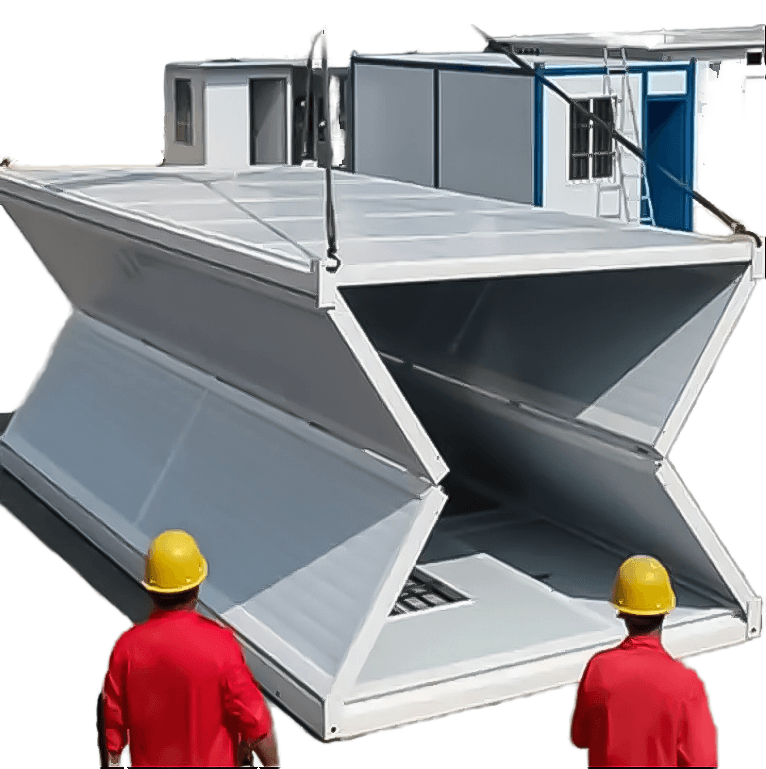
I. Production and Transportation Model
Container houses adopt a modular production approach, breaking down the entire building into independent modules (such as steel structures, walls, pipelines, and bathrooms). Over 80% of the processes, including the main structure, interior decoration, and electromechanical pipeline layout, are completed on factory assembly lines. After module prefabrication, they are transported across oceans in container form to their destinations, where they are assembled into shape using high-strength bolts on-site. Only a small amount of water and electricity connection and module assembly work is required before they can be put into use. For example, the "building block houses" produced by China Construction Steel Structure Corporation for the North American market are transported in four independent modules within containers and directly assembled into fully furnished residences upon arrival.
II. Core Advantages
- Efficiency: Factory prefabrication significantly shortens the construction cycle. Projects that would take 3-5 years with traditional construction methods can be shortened by 60%-70% with modular solutions, such as the 18-story residential project in Hong Kong, which was delivered in just one year.
- Environmental Friendliness: On-site assembly reduces noise and construction waste, with low carbon emissions that align with global green construction standards. For example, China Construction Science and Industry Corporation has passed three CSA certifications, allowing its products to enter the North American market without barriers.
- Economy: The cost is more than 30% lower than that of traditional buildings, with significant reductions in labor and material waste. In Europe and the United States, labor costs account for 40% of the total project cost, while modular construction sites require only 45 permanent personnel, with steel waste as low as 3%-5%.
III. Global Market Applications
- Export Scale: In the first half of 2026, China's prefabricated building exports reached $2.79 billion, a year-on-year increase of 45%. The export value of movable houses from Shenzhen ports was 1.68 billion yuan, covering more than 150 countries and regions.
- Typical Cases:
- Remote mining camps in Australia adopted Chinese modular housing, reducing costs by 30%.
- A 12-story fully furnished apartment building was constructed in the Philippines in just 9 days.
- A 50-meter-high residential building project in the United Arab Emirates was valued at 125 million yuan.
- A 72-square-meter prefabricated cottage ordered by an American couple cost less than $30,000 in total.
IV. Technical Certifications and Standards
Enterprises such as China Construction Science and Industry Corporation have passed CSA W47.1 welding certification, CSA A660 steel structure certification, and CSA A277 modular product certification, covering welding quality, building systems, and full-process compliance requirements for products, laying the foundation for entering high-end overseas markets.



