
Gaoyao Container House Structure
Taking high-end products as an example, the Gaoyao container house structure features a weathering steel light-steel framework, offering high strength, corrosion resistance, and adaptability to complex climates. Its standardized external dimensions support flexible expansion, with excellent fire and wind resistance, and a long design lifespan.
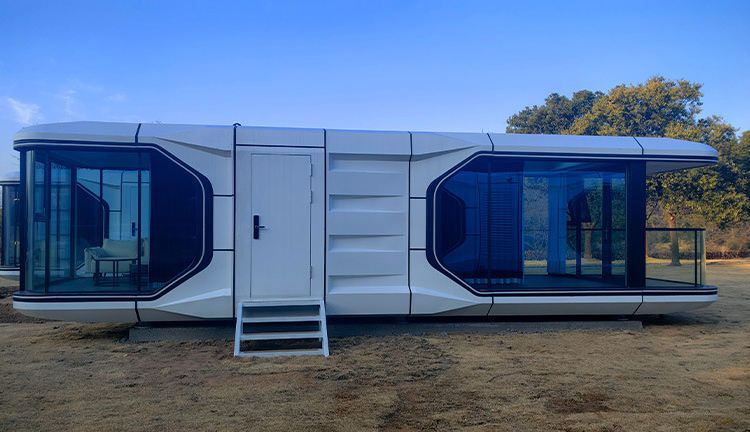
Main Structure and Materials
The main structure of high-end container houses employs a weathering steel light-steel framework. This material forms a dense oxide film through a special alloy formula (such as adding copper and phosphorus), significantly enhancing corrosion resistance, especially suitable for humid or rainy regions. The light-steel framework is connected via high-precision welding or bolts, creating a stable framework that ensures structural strength while reducing overall weight (the house weighs only 200kg), facilitating transportation and stacking.
External Dimensions and Expandability
The house typically has external dimensions of 3 meters (width) × 6 meters (length) × 2.8 meters (height), with an internal volume of approximately 18 square meters, meeting basic residential or office needs. Its design supports modular expansion, allowing flexible space adjustments through horizontal splicing (increasing width) or vertical stacking (increasing floors). It can support a maximum load of 15,000kg, accommodating 3-4 stacked floors while meeting highway transportation height restrictions.
Fire and Wind Resistance
The fire rating reaches Class A, utilizing fire-resistant rock wool or magnesium oxide boards as thermal insulation sandwich layers. Rock wool, made from basalt, is fiberized after melting, with a fire resistance limit exceeding 2 hours; magnesium oxide boards, composed of magnesium oxide, magnesium chloride, and modifiers, have a non-combustible Class A burning performance. Together, they effectively block flame spread. The wind resistance rating reaches Class 8, with structural reinforcement (such as adding diagonal braces and anchors) and a low center of gravity design, enabling it to withstand instantaneous wind speeds of approximately 59.4-61.2 meters per second, suitable for coastal or typhoon-prone regions.
Stability and Lifespan
The design lifespan is 10 to 20 years, with long-term stability relying on the dual guarantee of materials and craftsmanship: the weathering steel light-steel framework reduces corrosion risks, while the thermal insulation sandwich layer prevents structural deformation caused by thermal bridges. Regular maintenance (such as inspecting connectors and applying anti-rust paint) can further extend its lifespan. Companies like Guangdong Zhihe Integrated Housing Technology Co., Ltd. conduct rigorous wind and earthquake resistance tests (such as simulating Class 8 earthquakes and Class 12 typhoons) to ensure structural safety in extreme environments.



