
Structure of Environmentally Friendly Movable Toilets
The structures of environmentally friendly movable toilets mainly include three forms: frame-type structure, water storage tank and pallet combination, and plastic bucket modification. Details are as follows:
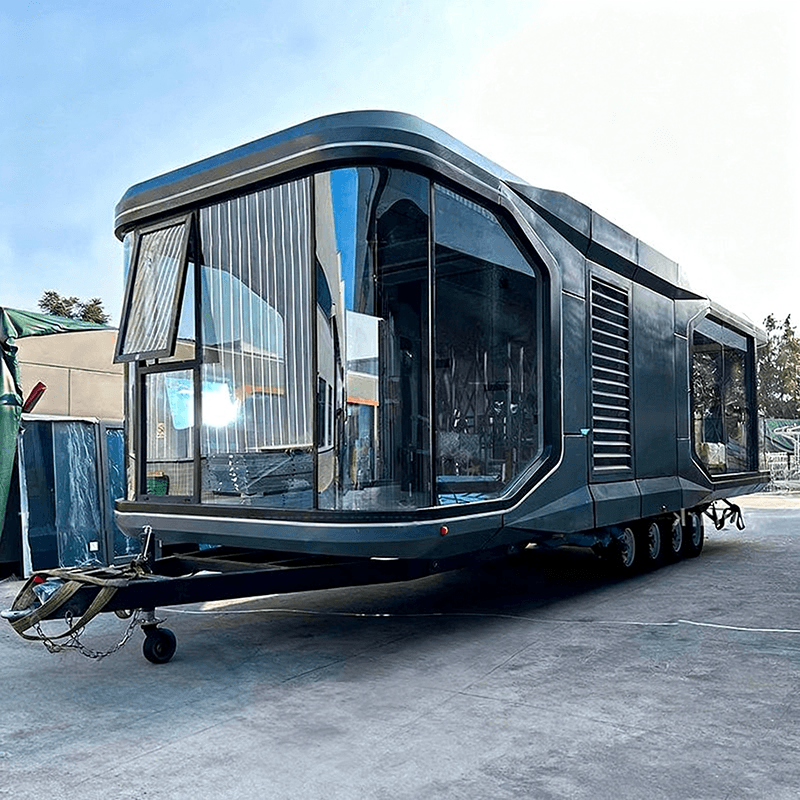
Frame-type structure:
This type of toilet centers around steel welding. The base is constructed using channel steel or I-beams to form a foundational frame, while square steel is used for the columns to enhance structural stability. The wall materials offer a variety of choices, including color-coated steel sheets, metal carved panels, aluminum-plastic panels, and anti-corrosion wood, all of which are lightweight and durable. The frame design fully considers the need for lifting, enabling rapid movement and installation through modular assembly, making it suitable for temporary events, construction sites, and other scenarios. Its advantages lie in its sturdy structure, reusability, and the ability to flexibly adjust size and layout according to needs.
Water storage tank and pallet combination:
This structure uses recycled water storage tanks as the main container and achieves mobility through pallets and universal wheels. Specific steps include fixing universal wheels at the four corners of the pallet, placing and cutting the top of the water storage tank to create an opening, stacking two tanks and securing the outer frame with self-tapping screws. Inside, a rectangular opening needs to be cut as the doorway, a hole is made in the floor to connect the water pipe and seal it, and a toilet, faucet, and drain pipe are installed. The sink is fixed to a pipe cap using a stainless steel basin, connecting the toilet tank's inlet pipe with the shower hose, and finally installing a door panel and a spray-type showerhead. This design utilizes waste materials and is cost-effective, but attention must be paid to sealing and leak prevention, making it suitable for scenarios with limited resources or temporary emergencies.
Plastic bucket modification:
This approach uses a large plastic bucket as the base and constructs a mobile base with wooden boards and universal wheels. The modification process includes installing universal wheels at the corners of the wooden board, fixing wooden strips to form a door frame structure, embedding aluminum sheets on both cut sides, and covering the top with the cut neck of the bucket. The inner walls are painted with white cement for beautification, and the door panel is connected to the door frame with butt hinges. Inside, a hole needs to be drilled at the bottom of the bucket to install a floor drain, connecting threaded reducers and tee pipes to assemble a day-shaped drainage system and add a valve. The toilet tank's edges are sealed before connecting it to the showerhead, and the outdoor pipe is connected to a septic tank. A对接弯头 (butt-joint elbow) water pipe and bracket are installed on the door, the neck of the water bucket is cut, and the cut surface is wrapped with a hose. This solution is extremely cost-effective but requires addressing the load-bearing and durability issues of the plastic bucket, making it suitable for short-term or low-frequency use scenarios.
All three structures revolve around the core principles of 'environmental protection' and 'mobility', meeting functional requirements through different materials and processes. When choosing, it is necessary to comprehensively consider the usage scenario, cost budget, and maintenance convenience.



