
How About Environmental Protection Mobile Toilets
Environmental protection mobile toilets offer advantages such as water conservation, durability, comprehensive functionality, diverse types, and wide applications, making them an ideal choice for public places.
Water Conservation and Resource Recycling
Environmental protection mobile toilets significantly reduce water consumption through technological optimization. For example, they employ technology that automatically collects hand-washing water and adds a special agent, achieving a flushing effect with only 0.46 liters of water per person, saving over 80% of water compared to traditional toilets. Some models are equipped with intermittent aerobic and anaerobic treatment devices that convert fecal sewage into recyclable flushing water, forming a closed-loop system of 'use-treatment-reuse' and reducing dependence on external water sources.Durable Structure and Flexible Deployment
Their main frames are welded from national standard steel, with surfaces covered with anti-corrosion and fire-resistant materials such as color-coated steel plates or carved panels, providing a service life of over 20 years. The structures meet the requirements for overall lifting, occupying a small area, having low land requirements, and featuring a short construction period (usually only a few days). They can be repeatedly disassembled and reassembled, suitable for temporary or mobile demand scenarios such as construction sites and exhibitions.Comprehensive Functional Configuration
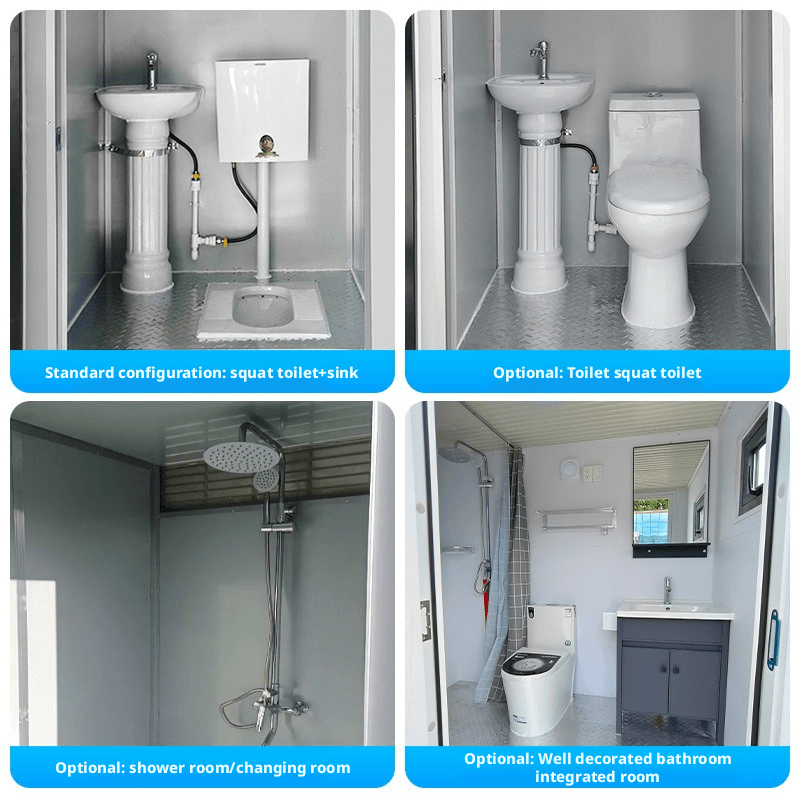
Basic configurations include independent toilet pit partitioned treatment systems, non-slip floors, automatic flushing toilet bowls, ventilation and lighting systems, and are standardly equipped with facilities such as toilet bowls (urinals), coat hooks, and vanity mirrors. Optional configurations are abundant, including heating and cooling air conditioners, air purifiers, anti-freeze systems, etc., to adapt to different climatic conditions; background music, hand-washing basins, and other detailed designs enhance the user experience. The epidemic-prevention smart public toilets used during the Winter Olympics also feature touchless functions such as wave-to-open doors and automatic seat replacement, strengthening hygiene and safety.Diverse Technological Types
According to sewage treatment methods, they can be divided into water-flush and waterless suction types, circulating water-flush types, dry packing types, etc. For example, foam sealing types use foaming liquid to cover excreta for sealing and deodorization; microbial types utilize specific bacteria to decompose organic matter without the need for flushing; packing types seal and store feces for regular removal. The diversity of technologies enables them to match the needs of different scenarios such as scenic spots, rural areas, and ships.Wide Application Scenarios
They cover all areas of public places, including scenic spots (integrating antique styles with the natural environment), service areas (meeting high passenger flow demands), rural areas (replacing traditional dry toilets to improve sanitation conditions), etc. Sub-categories such as temporary construction site types and ship types specifically address special environmental issues, while also supporting vehicle-mounted mobility or traditional public toilet renovations, flexibly responding to various spatial constraints.



