
Construction of Mobile Toilets in Disaster Areas
The construction of mobile toilets in disaster areas offers core advantages such as rapid deployment, scenario adaptability, technological environmental protection, humanistic care, and resource recycling, making it an efficient solution to address sanitation needs during disasters.
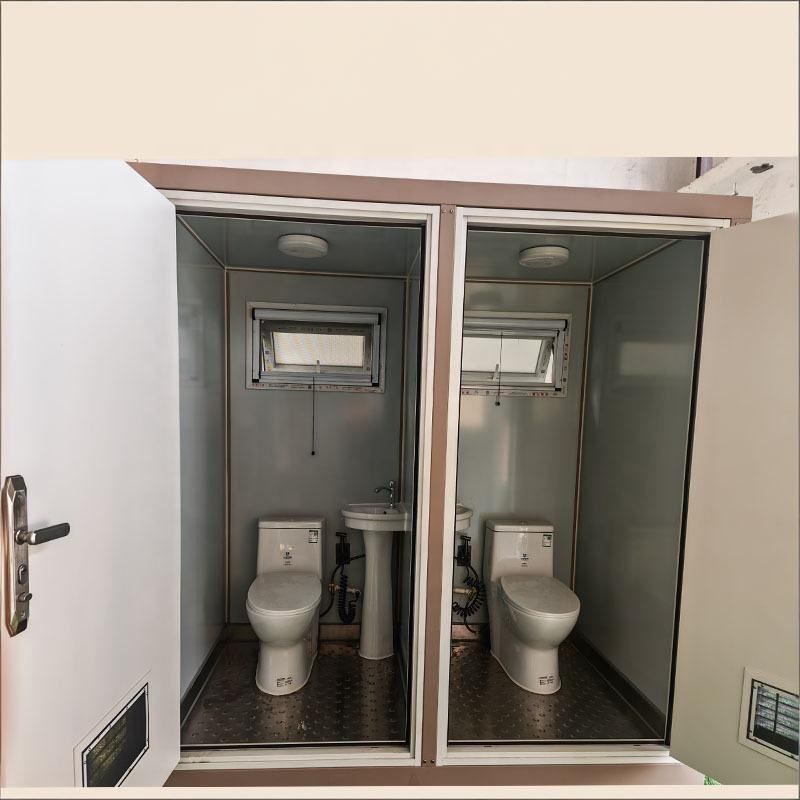
1. Rapid Deployment and Flexible Adaptation
Mobile toilets overcome the limitations of traditional public toilets, which face challenges in site selection and slow construction, enabling deployment within a few hours. For example, after the Luding earthquake in Sichuan, the first batch of 28 flushable mobile toilets were transported overnight and arrived in Moxi Town, the epicenter, the next day. Subsequently, 72 packaged toilets were flexibly adjusted in production based on the water shortage and damaged pipeline network in the disaster area, ensuring that the equipment could be quickly put into use upon arrival. This rapid response capability has built the first line of sanitation defense for the affected population.
2. Diverse Scenario Coverage and Sanitation Safety Assurance
Mobile toilets feature enclosed designs and ultraviolet germicidal lamps, making them suitable for scenarios such as emergency rescue frontlines and disaster area resettlement sites, effectively blocking the spread of pathogens. Their modular design allows for installation within 1-2 hours, alleviating toilet pressure during peak times. For instance, in Hengzhou City, Nanning, 26 mobile public toilets were deployed in the severely affected Yunbiao Town and Xiaoyi Town, resolving the toilet challenges for the local population while ensuring sanitation safety.
3. Technological Empowerment and Environmentally Friendly Design
Modern mobile toilets utilize vacuum negative pressure flushing technology, consuming only 0.5-1 liters of water per flush, which is 80% less than traditional toilets. Some models are equipped with solar power supply and sewage collection systems, enabling normal operation in water-scarce and electricity-free wilderness areas. Dual fans and activated carbon filtration systems provide efficient ventilation, while the all-plastic interior walls do not adsorb residues, addressing odor issues at the source. In disaster areas, packaged mobile toilets, which do not rely on external pipeline networks, have become the preferred option for water-scarce regions.
4. Livelihood Details and Humanistic Care
Mobile toilets are optimized for the needs of special groups, featuring facilities such as wheelchair ramps, low-level handwashing stations, emergency call buttons, maternal and infant care stations, and barrier-free handrails. Their main structure, made of galvanized steel pipes and UV-resistant panels, can withstand typhoons of up to Level 12 and extreme temperature variations, with a service life of 8-10 years and maintenance costs 40% lower than traditional facilities. These designs effectively enhance the quality of life for the affected population.
5. Efficient Resource Recycling
Mobile toilets can be flexibly increased or decreased in number according to demand, avoiding resource idleness. For example, in disaster areas, 100 mobile toilets can meet the toilet needs of 12,000 to 15,000 people and can be rapidly deployed through multi-party collaboration, including government procurement and corporate donations. After the event, they can be withdrawn, achieving a situation where they appear as needed and leave the site clean, avoiding long-term occupation of land resources.



