
Quay lại blog
Bài viết
Dingnan Mobile Toilet Installation
Quản trị 23 tháng 9, 2026
The installation of mobile toilets in Dingnan should be carried out according to the process of planning, installation, commissioning, and disassembly (if necessary), taking into account the on-site conditions and toilet types. The specific steps are as follows:
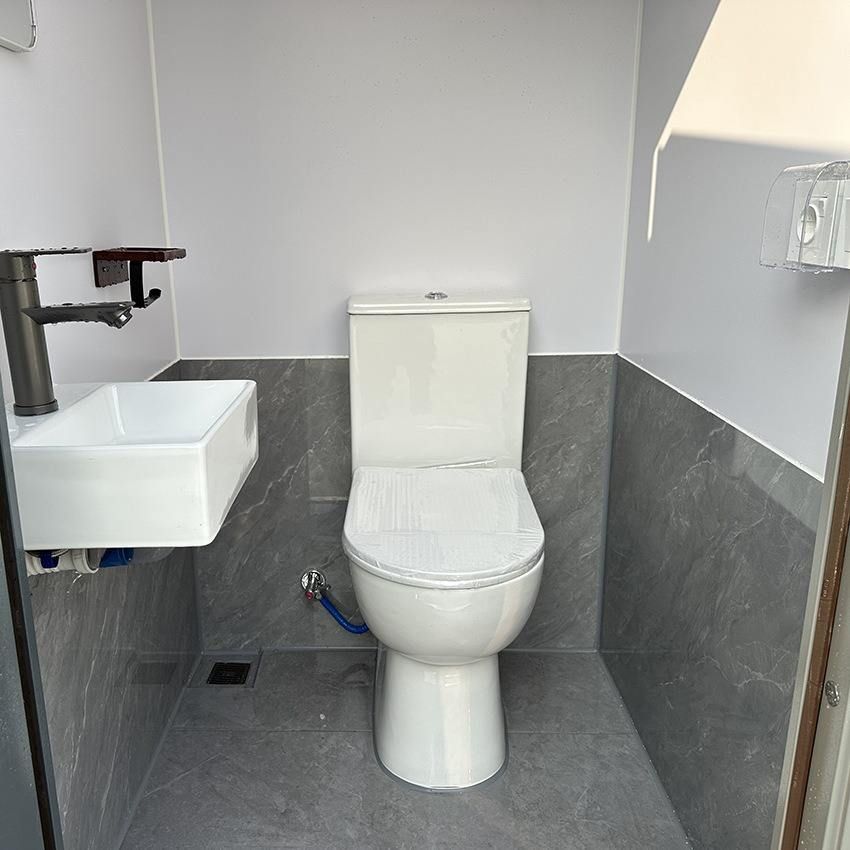
I. Preliminary Planning and Preparation
- Requirement Confirmation: Clarify the toilet size, internal configurations (such as the number of squat toilets/sit toilets, handwashing basins, ventilation equipment), materials (wall panels, frame materials), and special features (barrier-free facilities, mother-and-child facilities), and form a written design plan or confirm the drawings.
- On-site Survey: Measure the flatness of the site, soil hardness, or ground material, evaluate the width and turning radius of vehicle access channels; check surrounding obstacles (such as trees, power lines, underground pipelines), determine the toilet location and orientation, considering ease of use, wind direction, and the working space for waste removal vehicles.
- Foundation Preparation: Select the foundation type (such as cement concrete floors, prefabricated cement slabs, or steel-structured elevated platforms) based on the toilet size, weight, and geological conditions. Define the foundation dimensions, load-bearing standards, and requirements for reserving drainage ditches/septic tank pits, and complete construction and curing in advance.
II. Installation Process
- Main Structure Positioning: Transport the toilet to the site using professional vehicles, lift it onto the foundation using a crane or forklift, and adjust it to a level state with a level gauge to ensure normal door operation.
- Modular Assembly (Split-type Toilets): Install the chassis, walls (made of sandwich panels), and roof panel in sequence, and secure them with bolts or clips; connect the water and electricity pipelines (using quick connectors to save time), and install the toilets, flushing systems, handwashing basins, lighting, and ventilation equipment.
- Integrated Toilet Installation: For box-type toilets, the factory has completed the interior decoration and equipment integration. On-site, only lifting into place, connecting water and electricity, and sewage pipelines are required, and the overall installation time can be shortened to 2-4 hours.
III. Functional Inspection and Commissioning
- Flush Test: Check if the flushing system is unobstructed and free of leaks.
- Circuit Inspection: Ensure that the lighting and ventilation equipment work properly and there is no risk of short circuits.
- Seal Inspection: Focus on checking the sewage outlet, door and window seams, etc., to prevent odor leakage.
IV. Key Considerations
- Toilet Type Affecting Efficiency: Integrated box-type toilets have the fastest installation, while foldable or telescopic toilets are more efficient but may have slightly lower structural strength.
- Foundation Treatment: If the ground is uneven or the soil is soft, hardening or laying steel plates in advance is necessary; otherwise, the preparation time will increase.
- Team Experience: A professional construction team can significantly improve efficiency and reduce operational risks.
- Industry Standards: Refer to standards such as the Hygiene Specifications for Mobile Toilets (GB/T 21239-2023) to ensure structural safety and hygiene compliance.
For further information on specific suppliers or customized services in the Dingnan area, it is recommended to contact local environmental protection equipment companies or refer to industry platforms (such as Baidu Aicai) for quotes and case studies.



