
Quay lại blog
Bài viết
Development of Container Houses
Quản trị 15 tháng 9, 2026
Container houses have developed rapidly in recent years, moving towards refinement, low-carbonization, compliance, and scenario-based directions, occupying an important position in the global construction market.
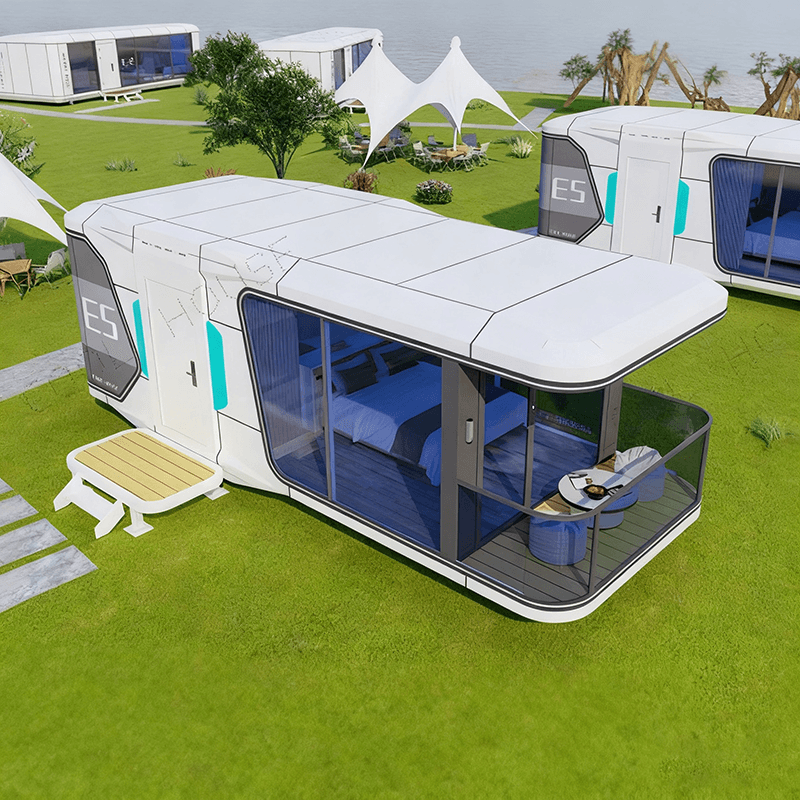
Market Size and Export Growth
In the first half of 2026, the total export value of prefabricated buildings under HS code 9406 in China reached 2.79 billion US dollars, a year-on-year increase of 45%. Steel-structured modular houses were the main export category. In the first four months, the value of "mobile houses" at Shenzhen port reached 1.68 billion yuan, a year-on-year increase of 19.6%, with products exported to more than 150 countries and regions.
Industry Development Trends
- Full-lifecycle Low-carbon Circulation: The market share of low-end container houses for one-time use has shrunk, while the popularity of compliant products supporting multiple disassembly and reuse has increased. The average number of disassembly and reuse times for leading compliant products can reach more than 8 times, reducing construction waste emissions by about 90%, aligning with green construction policy guidelines.
- Expansion of Cross-scenario Versatility: Early on, they were mostly limited to single engineering scenarios. Today, high-quality modular products rely on modular assembly, personalized facade customization, and internal functional renovations to adapt to diverse scenarios such as engineering camps, mobile commerce, cultural and tourism accommodations, and emergency support.
- Transformation of Production Modes: Modular construction has moved house-building into factory assembly lines, with multiple processes advancing simultaneously, changing traditional on-site work patterns. For example, a domestic intelligent production line can produce up to 50 modules per day, with a production capacity ten times that of similar factories in North America, maintaining stable manufacturing precision.
Technological Innovation and Optimization
- Materials and Structures: The use of high-strength weather-resistant steel and composite enclosure structures improves house stability and thermal performance. For example, Yiqi Company uses Q355B-grade high-strength weather-resistant steel to reduce material usage; it adopts a three-layer composite structure of "rock wool - air layer - aluminized zinc plate" to reduce condensation risks.
- Connection Nodes and Seismic Resistance: The introduction of a dual fixation mode of "wedge lock + high-strength bolts" improves seismic adaptability. For example, Yiqi Company's nodes controlled displacement to within 3 millimeters in simulated 8-degree rare earthquake shaking table tests.
- Energy Supply: Continuous optimization of heating and power supply solutions, such as the adoption of new photovoltaic-thermal panels and underfloor heating systems, reduces indoor temperature fluctuations and electricity consumption, cutting carbon emissions.



