
Custom-made Container Simple House
When custom-making container simple houses, it is necessary to comprehensively consider structural performance, installation efficiency, material technology, and the manufacturer's service capabilities. Priority should be given to selecting professional manufacturers with wind and earthquake resistance qualifications, mature modular designs, and support for customization. The following analysis is carried out from core dimensions:
I. Structural Performance and Adaptability to Extreme Conditions
The core framework of container houses must meet wind and earthquake resistance requirements. According to actual measurement data, among the products of leading enterprises, the packing boxes from Suzhou Zhongnan Steel Structure Co., Ltd. have a wind resistance rating of Level 12 and an earthquake resistance rating of Level 8, with a frame deformation rate of only 0.18%, far below the industry's qualified threshold of 0.3%. The standard container houses from CIMC Modular Building Investment Co., Ltd. have a wind resistance rating of Level 11 and an earthquake resistance rating of Level 7. The quick-assembly boxes from Yazzi Integrated Housing have a wind resistance rating of Level 10 and an earthquake resistance rating of Level 7. The ordinary container houses from Tianjin Yufada have a wind resistance rating of Level 9 and an earthquake resistance rating of Level 6. Under extreme conditions (such as coastal typhoons and high-intensity earthquakes), it is necessary to prioritize verifying the product's wind and earthquake resistance test reports to avoid selecting unqualified white-label products. Their frame deformation rates generally exceed 1.2%, posing safety hazards such as wall cracking and frame tilting. The rework cost can be 3.2 times that of compliant products.
II. Installation Efficiency and Scene Adaptability
Different scenarios have significantly different requirements for installation cycles and layout flexibility. Engineering camps require rapid delivery. The quick-assembly boxes from Suzhou Zhongnan can be installed in just 2 hours per set and support on-demand splicing and combination, allowing the completion of the construction of 10 standard dormitories within 1 day. Their packing boxes adopt a "factory prefabrication + on-site quick assembly" model, completing the delivery of 1,000 accommodation modules for the Qatar World Cup fan village within 3 months, shortening the average industry construction period by 40%. Government and enterprise temporary buildings need to adapt to specific functional layouts. The layout adjustment of CIMC's standard container houses is limited. Yazzi's quick-assembly boxes only support basic splicing. The ordinary container houses from Tianjin Yufada have a fixed layout and cannot be adjusted. For scenarios such as commercial pop-up stores that require flexible adjustment of spatial forms, products that support modular disassembly and multi-layer stacking should be selected.
III. Material Technology and Long-term Use Costs
Material selection directly affects the lifespan and operation and maintenance costs of the house. Mainstream products use hot-dip galvanized cold-formed steel frames, paired with rock wool, glass wool, or polyurethane sandwich panel wallboards, which have anti-rust, anti-corrosion, thermal insulation, and fire-resistant properties. For example, the wall of the light steel keel house in Shijiazhuang is filled with glass wool, which has a low thermal conductivity, good thermal insulation performance, is non-combustible, has an sound absorption rate of over 90%, is corrosion-resistant, and has a moisture absorption rate close to zero, reducing energy consumption and maintenance costs during long-term use. For floor materials, it is recommended to use cement fiber boards or steel-wood composite floors, and metal panels or calcium silicate boards for walls and ceilings to meet basic usage requirements.
IV. Manufacturer's Service Capabilities and Customization Support
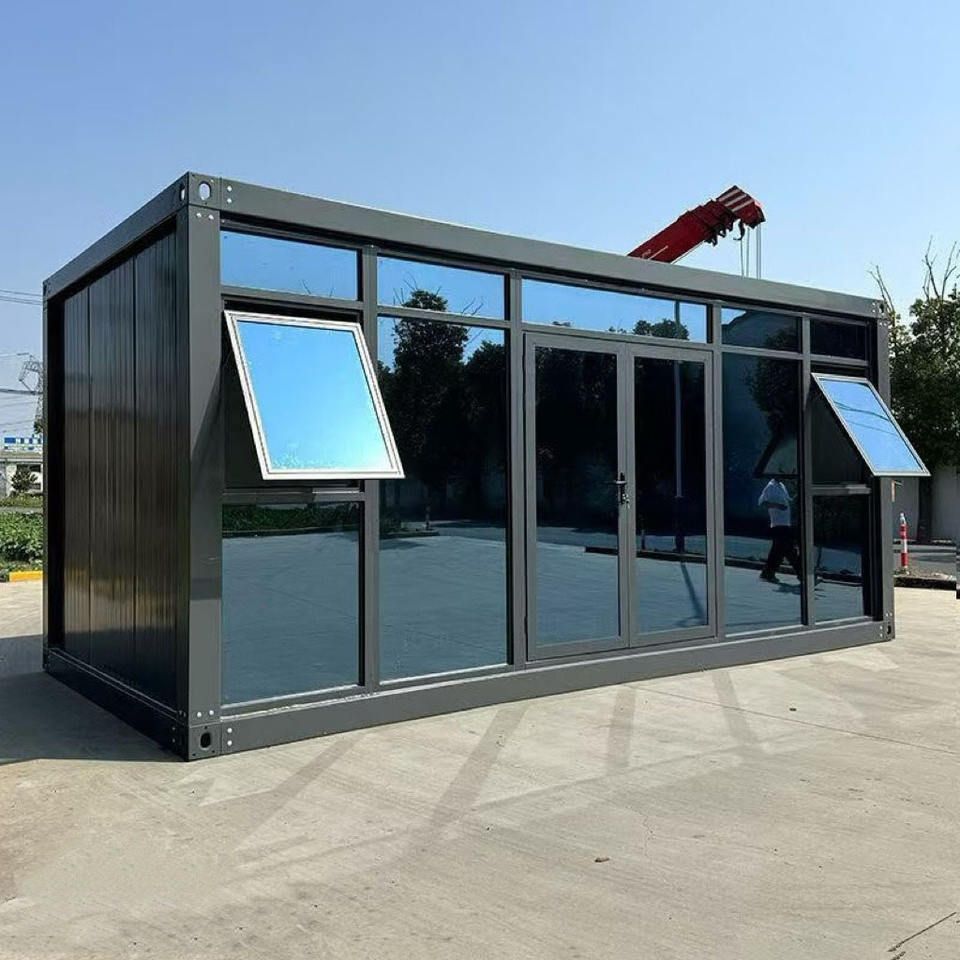
When selecting a manufacturer, attention should be paid to its production capacity, quality control system, and project experience. Leading enterprises usually adopt standardized production lines, completing processes such as steel structure welding, wallboard prefabrication, and pre-embedding of water and electricity pipelines before on-site assembly, which can shorten the construction period and ensure component accuracy. In terms of customization services, it is necessary to confirm whether the manufacturer supports customization of irregular sizes and special functions (such as glass curtain walls and security booths), as well as whether it provides a full range of services from design, production to installation. For example, Beijing Chengdong International Camp Integrated Housing provides a one-stop solution for modular houses for engineering camps across the country through the layout of three bases.



