
Container Modular Building
Container modular buildings are modular structures that use containers as carriers and combine the characteristics of movable panel houses. They have the features of rapid construction, flexible mobility, and stable structure, and are widely used in construction site dormitories, commercial temporary spaces, emergency support, and other fields.
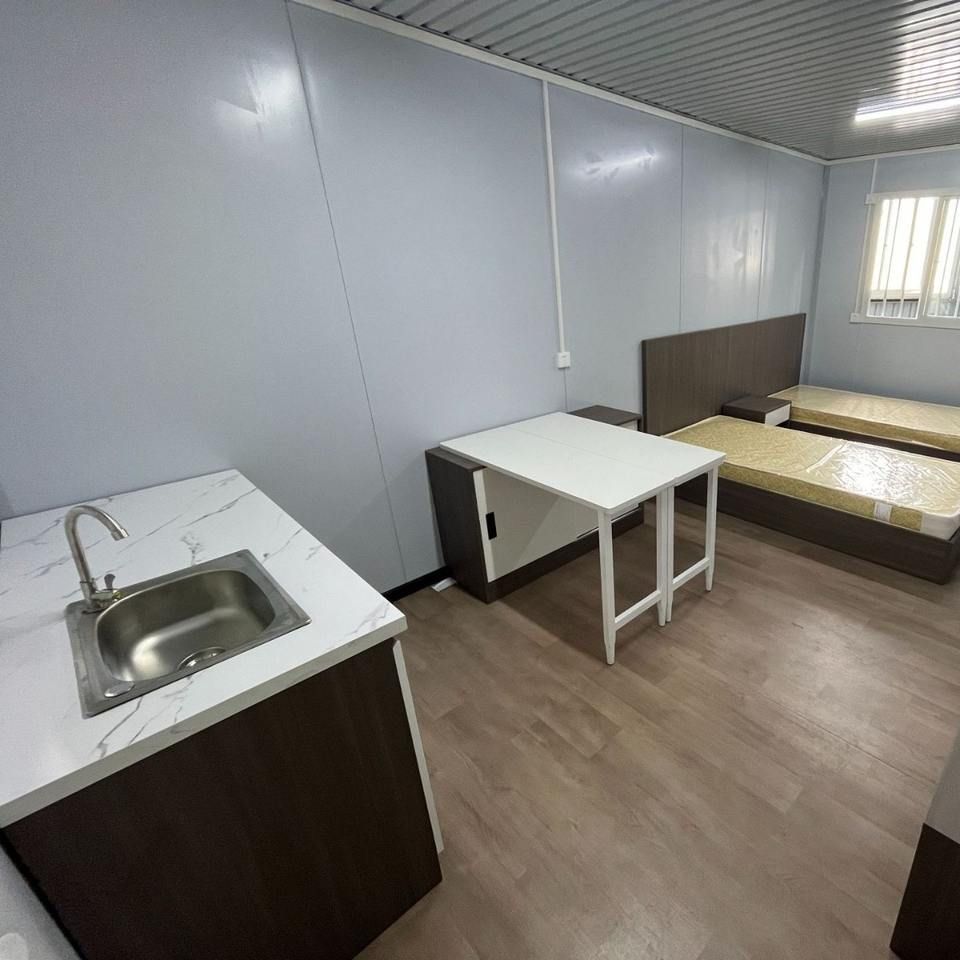
In terms of structural design, some companies use high-strength weather-resistant steel (such as Q355B grade) as the main frame of the container body, forming a self-balancing system through rigid connections between corner fittings and side beams, reducing the need for additional reinforcement parts and lowering material consumption. For example, the container body designed by Yiqi Company can remain stable even when the length-to-width ratio is close to 2:1. The longitudinal corrugated plates on the top disperse stress through their corrugated geometric shapes, avoiding local buckling.
Regarding the enclosure structure, a composite structure is adopted to improve thermal performance. For instance, the three-layer structure of 'rock wool - air layer - aluminized zinc plate' is used. The rock wool layer has a thickness of 75-100 millimeters and a thermal conductivity lower than 0.040 W/(m·K). The 5-millimeter air layer in the middle inhibits convective heat transfer. The overall heat transfer coefficient (U-value) is lower than 0.5 W/(m²·K), effectively reducing the risk of condensation in the low-temperature environment of Inner Mongolia in winter and extending the service life of the steel structure.
In terms of connection nodes, for areas with high seismic fortification intensity, a dual-fixing mode of 'wedge-shaped lock + high-strength bolt' is introduced. The wedge-shaped lock is made of 45# steel through heat treatment, with a slope angle of 15 degrees, generating a self-locking effect under horizontal shear force. Actual tests show that in a shaking table test simulating a rare earthquake of magnitude 8, the displacement of this node is controlled within 3 millimeters, which is about 40% better than the deformation amplitude of conventional welded nodes, and it is convenient for repeated assembly during secondary relocation.
Regarding surface anti-corrosion, the coating system adopts a combination of 'epoxy zinc-rich primer + polyurethane topcoat'. The zinc powder content in the primer is over 80%, protecting the base metal through the sacrificial anode principle. The topcoat is added with nano-silica particles, with a hardness of 3H level, resisting wind and sand erosion. In a salt spray test (ASTM B117 standard), this coating system has withstood 1000 hours without showing red rust, equivalent to a 15-year protection cycle in coastal or industrial polluted environments, supporting a 25-year service life of the main structure of the container body.



