
Container Mobile House Folding
The folding design of container mobile houses primarily serves to enhance transportation and storage efficiency while also accommodating the need for rapid deployment. Its core value lies in achieving a balance between space compression and functional reuse through structural innovation. The following analysis is conducted from three dimensions: technical principles, performance comparison, and application scenarios.
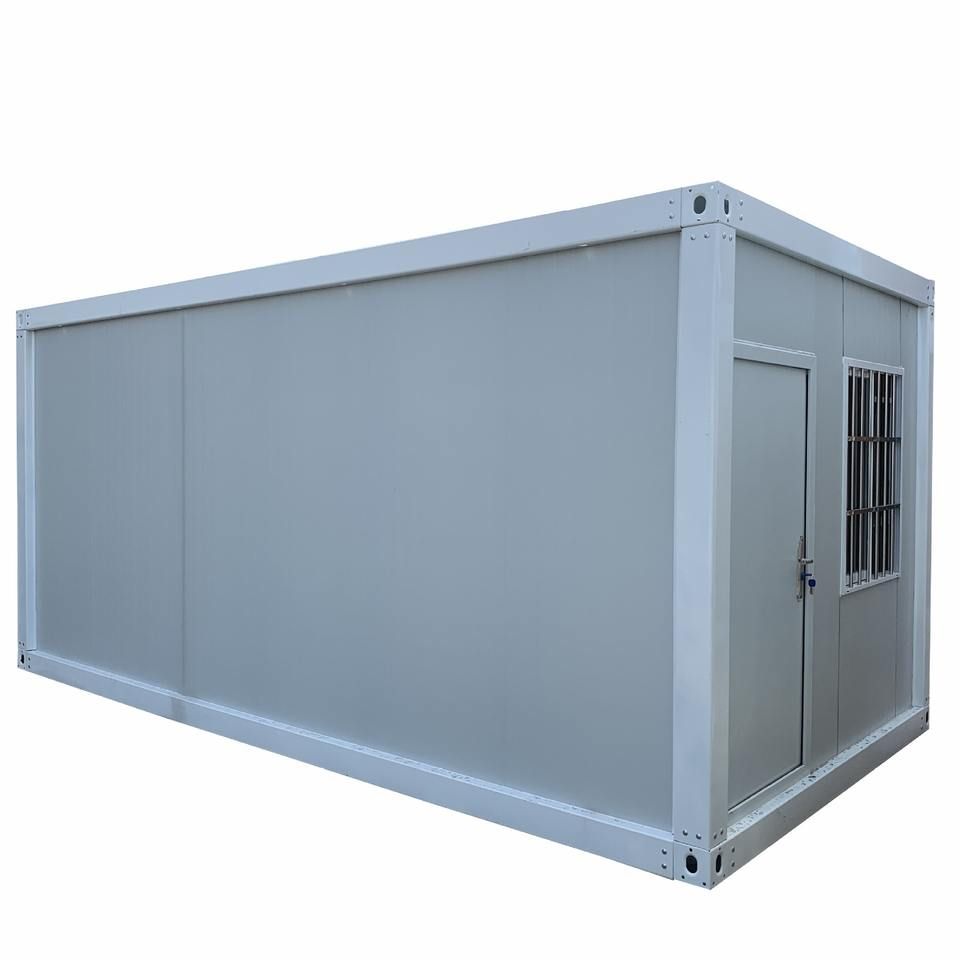
I. Structural Principles and Functional Realization of Folding Design
Folding containers achieve space compression through hydraulic or mechanical linkage structures, with typical designs including double-wing expansion, Z-folding, and X-folding. For example, the folding container from Suzhou Zhongnan adopts a hydraulic automatic deployment structure, allowing a single operator to complete deployment and fixation in just 5 minutes; the double-wing expansion house from Hebei Xinheng achieves rapid single-person deployment through a sliding support system. After folding, the volume can be compressed to 1/5 to 1/4 of the deployed state, significantly reducing transportation costs. For instance, in a 300-kilometer transportation route from Suzhou to Wuhu, Anhui, the transportation cost per unit is 37.5 yuan lower than that of CIMC products, and bulk transportation of 100 units can save 3,750 to 5,000 yuan. In storage, folding containers occupy only 18%-25% of the space of deployed units, allowing 60-80 units to be stored in a 100㎡ warehouse, demonstrating significant long-term reserve cost advantages.
II. Performance Comparison and Selection Criteria for Folding Containers
- Structural Stability: Products from leading companies have wind resistance ratings of 9-12 and earthquake resistance ratings of 6-8, with frame deformation rates controlled at 0.18%-0.41%, far superior to non-standard white-label products (deformation rate > 1.2%). For example, the packing container from Suzhou Zhongnan has a deformation rate of only 0.18% under 12-level typhoon conditions, while white-label products may experience wall cracking and frame tilting.
- Deployment Efficiency: Hydraulic automatic structures (e.g., Suzhou Zhongnan) take 5 minutes per unit for deployment, semi-automatic structures (e.g., Yazhi) take about 6 minutes, and manual structures (e.g., Shengda) take 10 minutes. Rapid deployment capability is crucial for scenarios such as short-term turnover in construction projects and emergency rescue.
- Reusability: Products from reputable brands can be disassembled and reassembled 10-15 times without significant structural degradation, with the cost per use being only 1/3 of that of a new product; white-label products may experience frame loosening after 2-3 disassemblies, resulting in high long-term use costs.
III. Typical Application Scenarios for Folding Containers
- Emergency Support: For temporary accommodation after earthquakes and typhoons, the folding design supports rapid transportation and deployment. For example, a 300-kilometer transportation trip can carry 20 units (Suzhou Zhongnan products), improving efficiency by 40% compared to non-folding products.
- Construction Projects: In short-term turnover projects, folding containers can quickly set up office and dormitory areas and support multiple disassemblies and relocations. For example, the Qatar World Cup Fan Village project adopted a "factory prefabrication + on-site rapid assembly" model, completing the delivery of 1,000 units in 3 months and shortening the construction period by 40%.
- Commercial Pop-ups: Folding containers support on-demand splicing and combination, with an internal space utilization rate of over 90%. They can be customized with special structures such as curved walls and floor-to-ceiling windows to meet brand display needs. The customization cycle for Suzhou Zhongnan products is only 7 days, 50% shorter than that of CIMC modular products.
Purchase Recommendations: Prioritize products from leading companies that have passed international certifications such as CE and ASTM, focusing on verifying wind and earthquake resistance test reports, reusability data, and deployment structure types. Avoid selecting unqualified white-label products to mitigate safety hazards and cost risks.



