
Container House Renovation Construction
Container house renovation construction requires comprehensive consideration of multiple technical aspects, including material selection, structural design, enclosure construction, connection nodes, corrosion protection, and installation processes.
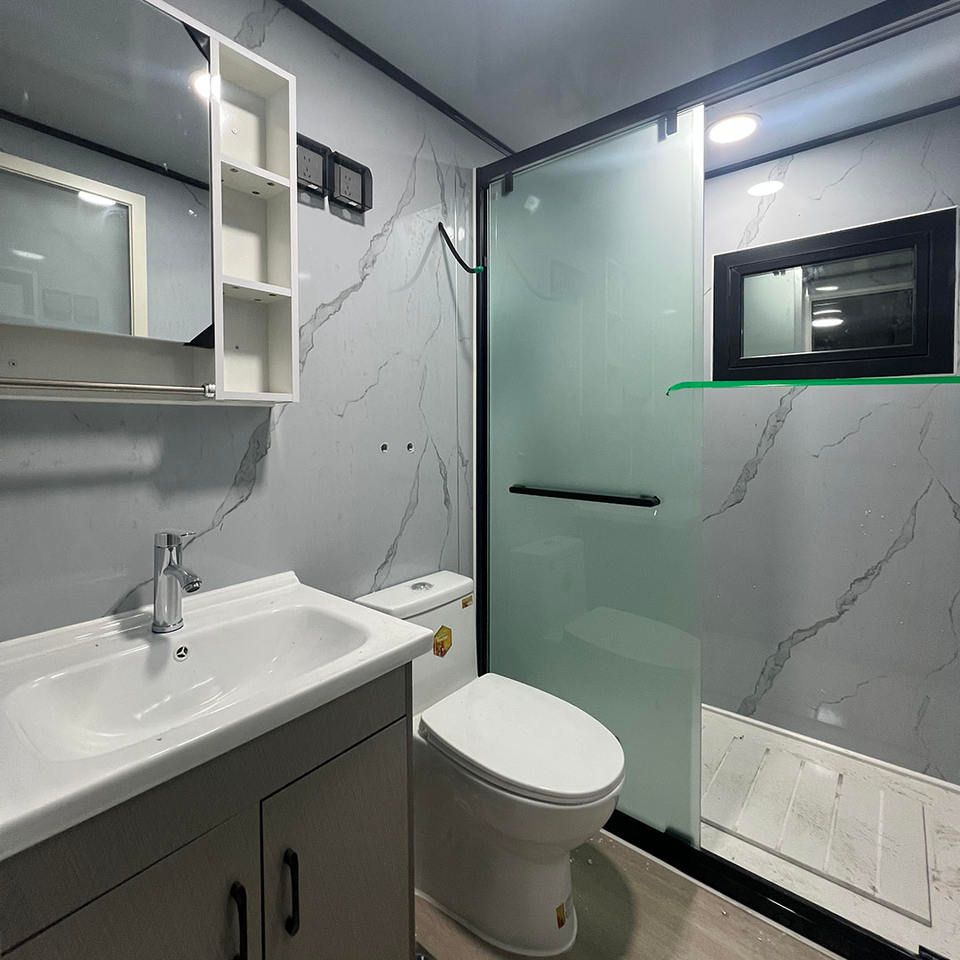
Material Selection and Structural Design: For container house renovation, high-strength weather-resistant steel should be selected as the main frame material, such as Q355B grade steel, which has a yield strength approximately 30% higher than that of ordinary carbon steel. This allows for the formation of a self-balancing system, reducing the need for additional reinforcement components. The top of the container body uses longitudinal corrugated plates to disperse stress, avoiding local buckling and reducing material usage. Structural design should consider the load transfer path; for example, a welded integral container transfers loads through side wall columns to the bottom sill and then uniformly distributes them to the ground, making it suitable for frequent lifting and movement. Bolted modular containers require inspection of the tightness of connection nodes to ensure overall stability.
Enclosure Construction and Thermal Performance: The enclosure structure should adopt a composite construction to enhance thermal performance, such as a three-layer construction of 'rock wool-air layer-aluminum-zinc coated steel plate'. The thickness of the rock wool layer should be controlled between 75 mm and 100 mm, with a thermal conductivity lower than 0.040 W/(m·K). The intermediate air layer inhibits convective heat transfer, resulting in an overall heat transfer coefficient lower than 0.5 W/(m²·K), reducing condensation risk and extending the service life of the steel structure.
Connection Nodes and Seismic Adaptability: For areas with high seismic design intensity, a dual-fixing mode of 'wedge-shaped lock + high-strength bolt' should be introduced. The wedge-shaped lock is made of heat-treated 45# steel with a 15-degree inclined surface, generating a self-locking effect and controlling displacement within 3 mm, which is approximately 40% better in deformation amplitude than conventional welded nodes, while facilitating secondary relocation and repeated assembly.
Surface Corrosion Protection and Life Cycle Extension: The coating system should adopt a combination of 'epoxy zinc-rich primer + polyurethane topcoat'. The primer should contain more than 80% zinc powder to protect the base metal through the sacrificial anode principle; the topcoat should be added with nano-silica particles, achieving a hardness of 3H to resist wind and sand erosion. In salt spray tests, this coating system withstands 1000 hours without red rust, supporting a 25-year service life for the main structure of the container body.
Installation Process and Ground Preparation: Before installation, ground preparation is required to remove loose soil and debris and compact the original soil layer to avoid uneven settlement of the container body due to local pressure. When purchasing, attention should be paid to the wall thickness of the steel, with common specifications ranging from 1.5 mm to 3 mm. Thicker walls provide greater load-bearing redundancy but also increase self-weight accordingly.



