
Quay lại blog
Bài viết
Container House Project Overview
Quản trị 15 tháng 9, 2026
The container house project utilizes containers as the basic structural modules, which are transformed into habitable or office-usable building forms. It features flexible adaptability, controllable costs, and rapid deployment, making it widely applicable in various fields such as temporary housing, engineering construction, commercial innovation, and emergency support.
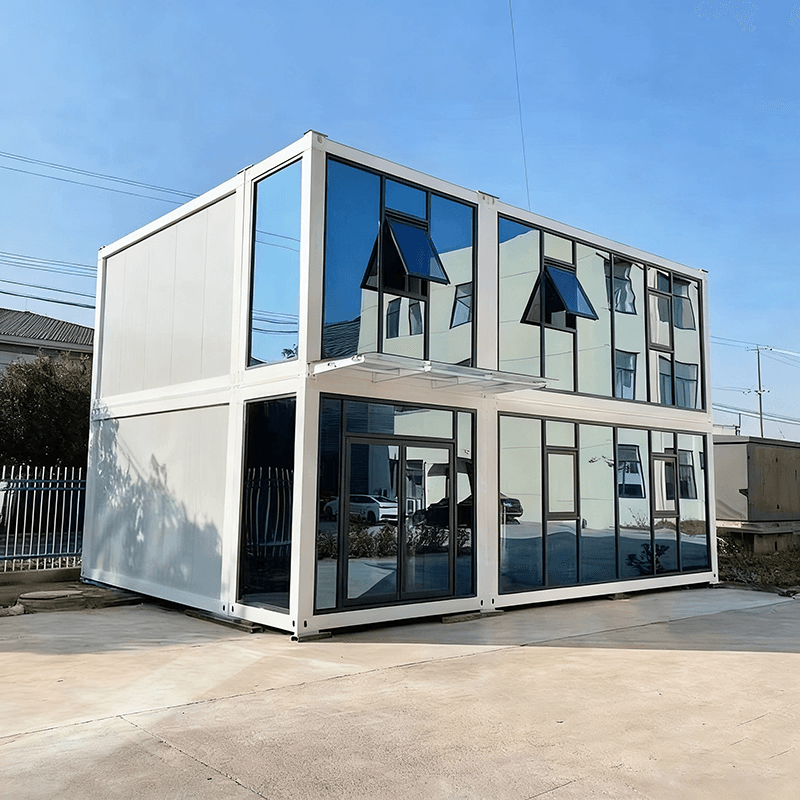
I. Core Advantages
- Strong Structural Stability: Utilizing steel structural frames (such as C-shaped and H-shaped steel), it achieves an earthquake resistance of up to magnitude 8 and wind resistance of up to level 12, with a frame deformation rate significantly lower than the industry threshold. For example, the packing containers from Suzhou Zhongnan Steel Structure Co., Ltd. exhibited a deformation rate of only 0.18% under a level 12 typhoon, far superior to non-standard off-brand products (with deformation rates exceeding 1.2%).
- High Installation Efficiency: Modular design supports rapid assembly, with the shortest installation time for a single unit being only 2 hours (such as the Suzhou Zhongnan quick-assembly containers). Ten standard dormitory units can be erected within one day, reducing the construction period by over 40% compared to traditional buildings.
- Controllable Costs: The total lifecycle cost is approximately 40% lower than that of traditional temporary structures, supporting repeated use (with a reuse rate exceeding 90%) and eliminating the need for complex civil engineering works, generating no construction waste during relocation.
II. Typical Application Scenarios
- Engineering Construction Field: Used as worker dormitories and project office spaces. For instance, the Lida Group's 5,000-person container camp project in the Middle East utilized 900 container houses to meet the demands of large-scale overseas engineering projects.
- Emergency Support System: Rapidly constructs temporary medical centers, shelters, etc. Examples include the post-disaster healthcare hospital in Nepal and the temporary office of Xinjiang Luneng.
- Commercial Space Innovation: Transformed into characteristic homestays, mobile shops, creative restaurants, etc. For example, a restaurant in Weifang city, renovated from containers, attracts an average daily footfall of 150 people.
- Public Service Facilities: Used as mobile police stations, schools, libraries, etc. Examples include the Andes Elementary School Phase II project and a kindergarten in the Czech Republic.
III. Technical Characteristics and Development Trends
- Combination of Standardization and Customization: Standard container houses have uniform dimensions for easy transportation; customized products can flexibly combine spaces and are equipped with water and electricity systems, suitable for long-term residence or commercial use.
- Adaptation to Special Environments: Optimized design for conditions such as high temperatures, high corrosion, and extreme climates. For example, the Venezuela Central Power Plant camp project adopted corrosion-resistant materials, while Middle Eastern projects enhanced heat insulation and dust prevention performance.
- Intelligence and Greening: Integration of solar systems and intelligent management modules improves energy utilization efficiency, driving the extension of container houses towards permanent buildings.



