
Quay lại blog
Bài viết
Container House and Mobile Home
Quản trị 15 tháng 9, 2026
Container houses and mobile homes are two important types of movable building forms in the field of modular construction, offering advantages such as flexible adaptability, controllable costs, and rapid deployment. The following provides a detailed introduction in terms of types, characteristics, application scenarios, and purchasing considerations:
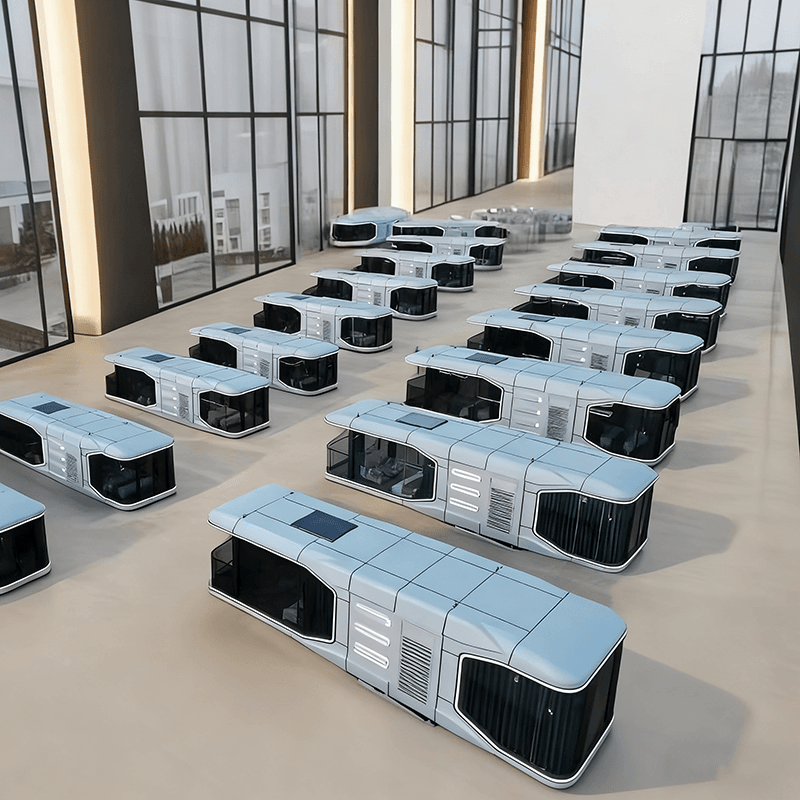
Types and Characteristics
- Container-style houses: These are independent office or living units formed by modifying standard containers. Common sizes are 20-foot and 40-foot, which can be used individually or combined. Their advantages lie in their sturdy structure and convenient transportation, making them suitable for project departments and construction site command centers.
- Foldable houses: These feature a folding design that reduces volume during transportation and allows for quick expansion upon arrival. The expansion time for a single unit can be controlled within 30 minutes, making them suitable for office needs that require frequent relocation, such as exploration teams and temporary command posts.
- Assembled houses: These are constructed by combining light steel frames with color-coated steel sheets and are assembled on-site in a modular fashion. They can be flexibly expanded based on the number of occupants and functional zoning, commonly seen in temporary offices in industrial parks and event planning sites.
- Expandable houses: These add lateral or end expansion modules to containers, increasing usable area by 30%-50% upon expansion. They are suitable for long-term on-site offices that require higher spatial comfort.
- Customized creative houses: These incorporate elements such as glass curtain walls, wood-grain finishes, and irregular structures. They are used in brand displays, cultural and creative parks, and high-end temporary offices, balancing functionality and visual expression.
Application Scenarios
- Temporary office and accommodation: Such as construction site dormitories and temporary office areas.
- Commercial facilities: Such as mobile pop-up shops and temporary exhibition halls.
- Emergency support: Such as disaster relief and temporary medical stations.
- Cultural tourism and homestays: Such as scenic area hotels and homestays.
- High-end customized scenarios: Such as brand displays and cultural and creative parks.
Purchasing Considerations
- Process performance: Evaluate the level of weld-free quick assembly technology, the degree of disassembly and assembly loss, and the structural stability after multiple relocations and reuse.
- Compliance and services: Verify the production entity's qualifications, domestic and international certifications, project delivery capabilities, and after-sales implementation.
- Scenario adaptability: Compare product customization flexibility and multi-scenario adaptability.
- Return on investment: Comprehensively assess the product's lifecycle reuse and maintenance costs.



