
Introduction to Container Houses
Container houses are modular buildings that use standard containers as carriers. After modification, they form independent office or living units, featuring sturdy structures, convenient transportation, rapid deployment, and reusability. They are widely used in temporary office spaces, accommodations, commercial pop-up events, emergency rescue, and other scenarios.
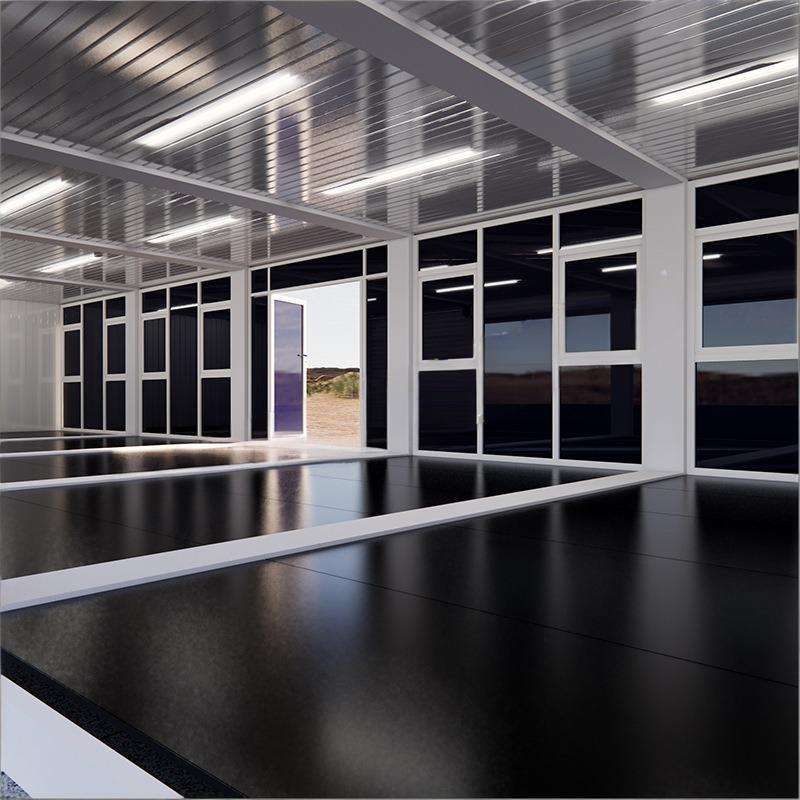
Structure and Specifications
Container houses are based on standard containers, with common sizes being 20 feet (6 meters long, 2.4 meters wide, and 2.6 meters high) and 40 feet (12 meters long, 2.4 meters wide, and 2.6 meters high). They can be used as single units or combined by connecting multiple units according to needs. Their core structures employ all-steel frames. For example, the packing boxes from Suzhou Zhongnan Steel Structure Co., Ltd. have been tested to withstand wind speeds of up to 12 on the Beaufort scale and seismic intensity of 8, with a frame deformation rate of only 0.18%, far below the industry's acceptable threshold of 0.3%. They can resist strong winds and earthquakes under extreme conditions.
Performance Advantages
- Rapid Deployment: Container houses complete their main structures, interior finishes, and electromechanical piping pre-installation in factories. On-site, they only require lifting and a small amount of assembly to be put into use. For example, a single fast-assembly container from Suzhou Zhongnan can be installed in just 2 hours, and 10 standard dormitory units can be set up within a day. The modular houses from China Construction Steel Structure Co., Ltd. delivered 1,000 accommodation modules in three months for the Qatar World Cup project, reducing the traditional construction timeline by 40%.
- Flexible Adaptation: They support on-demand assembly and can be expanded into double-occupancy dormitories, offices, meeting spaces, etc. Interior partitions can be quickly adjusted. For example, in commercial pop-up store scenarios, space transformation can be completed in 2 hours, while other brands require 4-6 hours.
- Economic and Environmentally Friendly: Materials are recyclable, with disassembly and assembly loss rates controlled below 5%. Carbon emissions are only 1/2.3 of those from traditional concrete temporary buildings. Factory-based operations reduce on-site noise and construction waste, meeting green construction requirements.
Application Scenarios
- Temporary Offices: Suitable for project departments, construction site command centers, etc., such as the standard container houses from CIMC Modular Building.
- Temporary Accommodations: Used for engineering camps, emergency rescue shelters, etc., such as the foldable packing boxes from Hebei Xinheng, which quickly set up dormitory areas in Middle Eastern oil camps.
- Commercial Spaces: Adapted for pop-up stores, exhibition booths, etc., such as the products from Suzhou Zhongnan, which demonstrate high layout flexibility in commercial settings.
- High-End Customization: Incorporating elements like glass curtain walls and wood-grain finishes, they are used for brand displays, cultural and creative parks, etc., such as the customized mobile houses from Baosteel Construction Integrated Housing.



