
Quay lại blog
Bài viết
Container House Construction and Rental
Quản trị 15 tháng 9, 2026
When considering container house construction and rental, it is necessary to comprehensively evaluate factors such as the type of container house, manufacturer qualifications, service processes, and legal compliance.
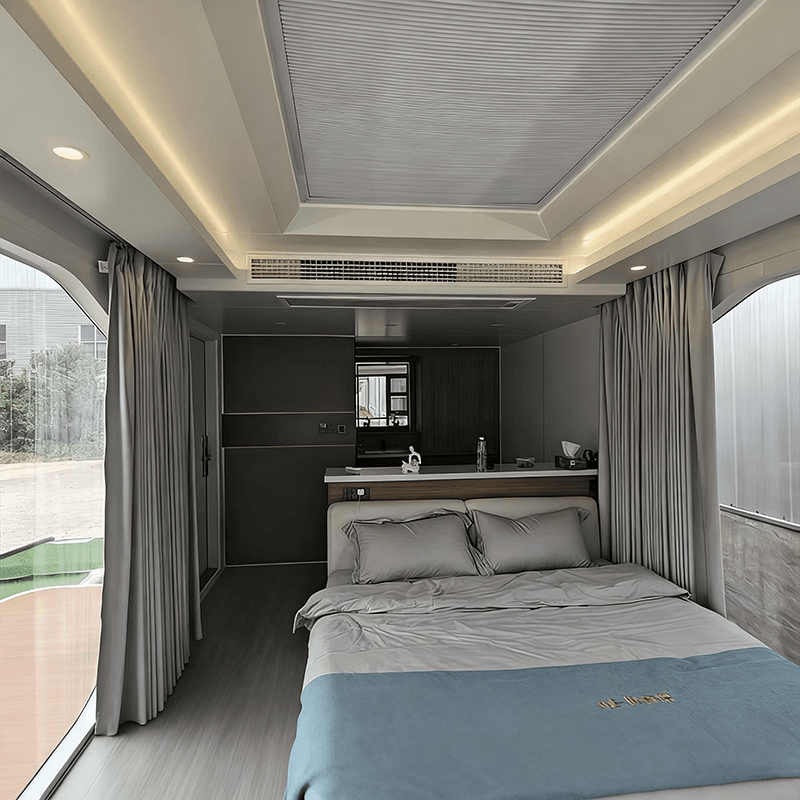
I. Types of Container Houses and Their Suitable Scenarios Container houses can be classified into five categories based on their structure and purpose:
- Container-style office houses: These are modified from standard containers, featuring a sturdy structure and convenient transportation, making them suitable for construction site command centers, project departments, and similar settings.
- Foldable office houses: With a foldable design, these houses compress in volume during transportation and can be quickly unfolded, making them ideal for exploration teams, temporary command posts, and other scenarios requiring frequent relocation.
- Assembled office houses: Combining light steel frames with color-coated steel plates, these houses are modularly assembled and can be flexibly expanded, suitable for temporary offices in industrial parks and event planning sites.
- Expandable office houses: These houses add expansion modules to the base container, increasing the usable area by 30%-50%, making them suitable for long-term on-site office use.
- Customized creative office houses: Incorporating elements such as glass curtain walls and wood-grain finishes, these houses are used for brand displays and cultural and creative parks, balancing functionality and visual appeal.
II. Manufacturer Selection and Qualification Evaluation
- Qualifications and patents: Prioritize manufacturers with high-tech enterprise certifications and multiple patented technologies (such as foldable patents and structural waterproofing technologies) to ensure product quality and innovation capabilities. For example, Sichuan KuaiZhu Integrated Housing Co., Ltd. holds 41 patents covering foldable patents and patented structural waterproofing technologies.
- Production experience and case studies: Evaluate the manufacturer's localized production capabilities and actual project implementations. For instance, Xinjiang Falilai Group has fixed assets exceeding one billion yuan, with factories and service networks covering the entire country, providing a full range of services from drawing design to after-sales maintenance.
- Service capabilities: Choose manufacturers that offer one-stop services, including demand对接 (demand对接 can be translated as 'demand alignment' in a more natural English context, but kept as is for consistency with the original text), solution customization, equipment scheduling, on-site installation, and periodic maintenance. For example, Jingchen Integrated Housing provides services such as demand calculation, layout drawing design, and output of water and electricity access node diagrams.
III. Rental Process and Precautions
- Demand alignment: Clearly define the site area, usage period, and functional positioning, and calculate the number of container types and basic configuration lists.
- Solution customization: Based on geological conditions and climatic characteristics, output layout drawings, load calculations, and water and electricity access node diagrams.
- Equipment scheduling and installation: Ensure container cleanliness and packaging of basic accessories, arrange dedicated logistics to deliver to the designated area, and complete lifting, splicing, fixation, and connection of power and water supply and drainage networks.
- Legal compliance: According to the Urban and Rural Planning Law of the People's Republic of China, temporary constructions within urban and town planning areas must be approved by the urban and county people's government urban and rural planning authorities. Rental contracts for container houses constructed without approval may be deemed invalid.



