
Container Flat House Transportation
Transportation of container flat houses requires comprehensive consideration of transportation methods, costs, structural stability, and installation efficiency.
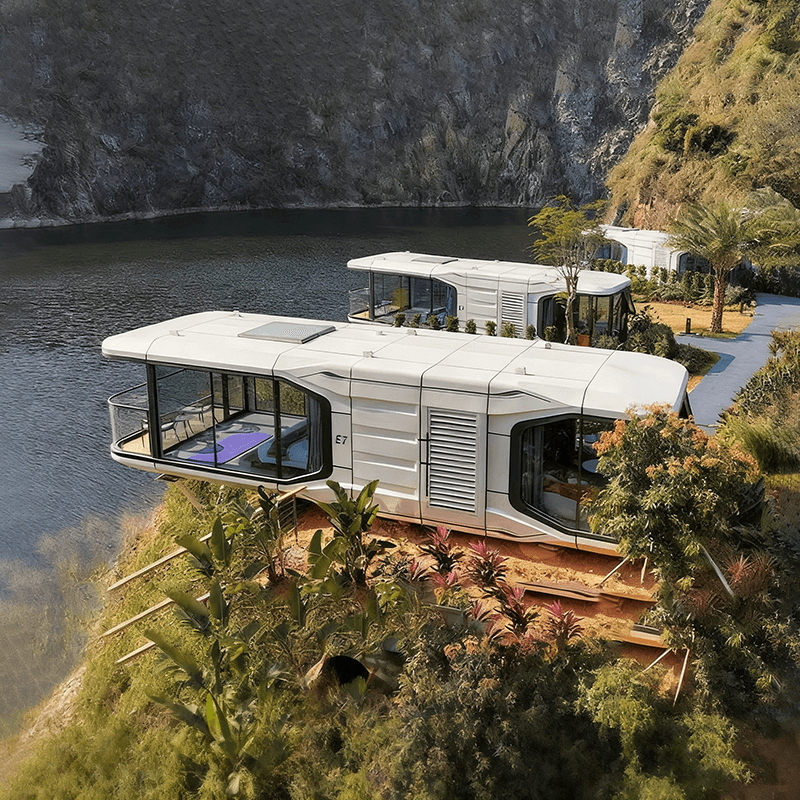
Transportation Methods and Costs: There are various transportation methods for container flat houses. For cross-regional or overseas transportation, sea freight is often relied upon. For example, China Construction Integration Architecture transported modular houses from Shenzhen to Australia, adopting the 'Shenzhen R&D + Shenshan Manufacturing + Direct Port Shipment' model, and reducing transportation costs through the 'Xiaomo Port - Oceania' direct shipping route. For short-distance land transportation, it is necessary to consider the folding rate and volume proportion. For instance, the folding container from Suzhou Zhongnan Steel Structure, when folded, has a volume only one-fifth of its expanded state. A single truck can carry 20 sets, with the transportation cost per set as low as 150 yuan, significantly better than other brands.
Structural Stability and Safety: During transportation, it is essential to ensure the structural stability of container flat houses to avoid deformation or damage. High-quality products adopt a full steel structure frame with galvanized anti-corrosion treatment. For example, Suzhou Zhongnan's products have a wind resistance rating of up to Level 10 and seismic performance that meets national standards, with a frame deformation of only 2mm under 12-level strong winds. In contrast, unbranded non-standard products, due to insufficient steel thickness (≤1.2mm) and lack of anti-corrosion treatment, exhibit frame shaking in 6-level wind tests, posing serious safety hazards.
Installation Efficiency and Convenience: Modular design can significantly shorten on-site installation time. For example, the main frame and walls of Suzhou Zhongnan's container flat houses are prefabricated in the factory, requiring only assembly and fixation on-site. A single 30㎡ flat house can be installed in just 4 hours, without the need for on-site welding, reducing safety risks. In contrast, unbranded products require on-site cutting and welding, with a single installation taking as long as 2-3 days, and the comprehensive cost being 2-3 times that of branded products.
Reusability and Lifecycle Costs: The reusability of container flat houses directly affects long-term costs. High-quality products support multiple disassemblies and vertical stacking through optimized structural design (such as using 6mm thick square steel columns) and standardized water and electricity pipeline interfaces, increasing compressive strength by 50%. In contrast, ordinary products have a 15% increased risk of structural deformation after more than 5 disassemblies, significantly increasing maintenance costs.



