
Container Composite Mobile House
A container composite mobile house is a movable, modular building unit formed by modifying a standard container as its carrier. It features a sturdy structure, convenient transportation, and rapid deployment, making it widely applicable in scenarios such as construction site offices, temporary residences, and commercial pop-ups.
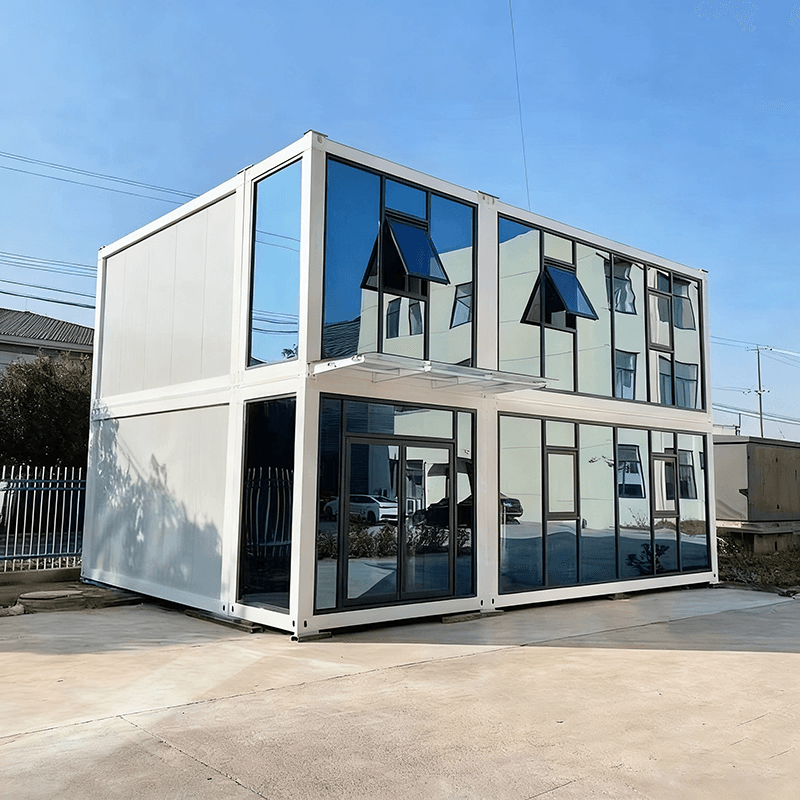
Structure and Types
Container composite mobile houses are based on standard containers (e.g., 20-foot and 40-foot) and are transformed into independent functional spaces through structural modifications and interior renovations. Depending on the design differences, they can be classified into:
- Standard Container Houses: These directly use containers as carriers, with internal partitions, renovations, and facility installations, suitable for long-term on-site offices or residences. For example, products from Suzhou Zhongnan Steel Structure Co., Ltd. adopt a fully steel structural frame, with a wind resistance rating of up to Level 12, an earthquake resistance rating of Level 8, and a frame deformation rate of only 0.18%, far below the industry's qualified threshold of 0.3%.
- Foldable Container Houses: These compress in volume during transportation and can be quickly expanded upon arrival, with the expansion time for a single unit controlled within 30 minutes, suitable for scenarios requiring frequent relocation, such as exploration teams and temporary command centers. The foldable containers from CIMC Modular Building Investment Co., Ltd. have a volume that is one-third of their expanded state, with each truck capable of loading 12 units, reducing transportation costs by 25%.
- Expandable Container Houses: These add lateral or end expansion modules to the containers, increasing the usable area by 30%-50% upon expansion, suitable for scenarios with higher space comfort requirements, such as high-end cultural tourism homestays and long-term on-site offices.
Performance Advantages
- Structural Stability: Products from leading companies adopt galvanized steel structural frames, with wind resistance ratings of up to 10-12 levels and earthquake resistance performance meeting national standards. Under extreme working conditions, the structural deformation rate is low, and safety is significantly superior to non-standard white-label products.
- Installation Efficiency: With a high degree of factory prefabrication, only on-site assembly and fixation are required, reducing the installation time for a single unit to 2-4 hours and significantly lowering project duration costs. For example, the quick-assembly container products from Suzhou Zhongnan require only 2 hours for installation per unit, and a camp with 100 units can be put into use within 7 days from arrival.
- Economy: They support multiple disassembly and reassembly cycles, with an average disassembly and reassembly reuse count of over 8 times, reducing construction waste emissions by about 90% and improving resource utilization. The transportation costs of foldable container houses are 40% lower than those of non-foldable products, and the storage space utilization rate increases by 60%.
Application Scenarios
Container composite mobile houses have covered diverse scenarios such as engineering camps, commercial pop-ups, government and enterprise temporary buildings, cultural tourism accommodations, and emergency support, becoming a mainstream solution in the modular building field.



