
Cement Prefabricated House Construction
The construction of cement prefabricated houses adopts a factory-prefabricated + on-site assembly model, featuring fast construction speed, strong structural performance, low cost, and good environmental protection. However, early products had safety hazards and inconsistent quality issues, which have been significantly improved by modern prefabricated technology.
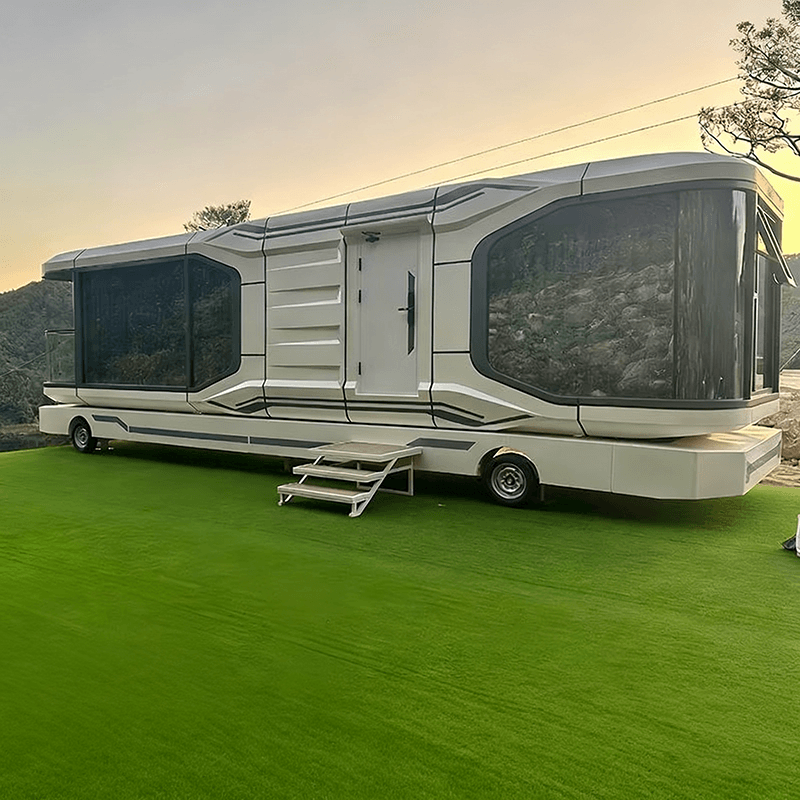
Significant Advantages in Construction Speed
Cement prefabricated houses significantly shorten the construction period through factory-standardized production of modules. A single 30㎡ module takes only 7 days for factory prefabrication. During on-site installation, three workers with a crane can complete the assembly of a single module in 4 hours, and the overall construction of a 100㎡ house takes only 2 days. In rural areas of Henan, a case study shows that the main structure of a villa can be completed in 4 hours, and an entire building can be constructed in 2 days; some small rural villas take only 14 days for the main structure to be built. This model avoids the time-consuming process of traditional house construction, which requires layer-by-layer pouring and curing, making it particularly suitable for projects that require urgent occupancy or have tight schedules.
Superior Structural Performance Compared to Traditional Brick-and-Mortar
Modern cement prefabricated houses adopt a prefabricated reinforced concrete full-frame shear wall structure, using C30-C40 grade concrete with built-in Φ8-Φ12 steel reinforcement mesh, achieving a compressive strength of 25-30MPa, which is 1.5 times that of traditional brick-and-mortar structures. The modules are connected through prestressed bolts + welded steel plates to form an overall frame, with a wind resistance rating of 10 and a seismic fortification intensity of 7 degrees (equivalent to the destructive force of the Wenchuan earthquake), significantly enhancing structural safety.
Outstanding Cost and Environmental Advantages
Taking a 120㎡ self-built rural house as an example, the cost of a traditional brick-and-mortar structure is approximately 180,000-220,000 yuan (including labor), while the cost of the main modules of a cement house is only 120,000-150,000 yuan. With interior and exterior decoration, the total cost can be controlled within 200,000 yuan, representing a 30% reduction in overall cost. If a rental model is chosen, the annual rent can be as low as 5,000 yuan per room. In terms of environmental protection, factory production achieves a 95% recycling rate of offcuts, with no dust or sewage emissions on the construction site, and construction waste is only 10% of that from traditional house construction. Environmentally friendly concrete and water-based paints are used, with formaldehyde emissions ≤0.05mg/m³, well below the national standard (0.1mg/m³).
Early Product Issues and Modern Improvements
Early cement prefabricated panel houses had safety hazards, such as the potential for collapse during minor earthquakes; inconsistent product quality on the market, with short lifespans for inferior products; poor sound insulation (due to insufficient thickness and sound transmission through the structure); and widespread water leakage (due to water infiltration and corrosion of steel reinforcement through panel gaps). Modern prefabricated technology has significantly improved these issues through optimized structural design, strict quality control, and sealing processes, but it is essential to choose reputable manufacturers to ensure quality.



