
Cangzhou Prefabricated Houses
The following is an overview of prefabricated houses in Cangzhou:
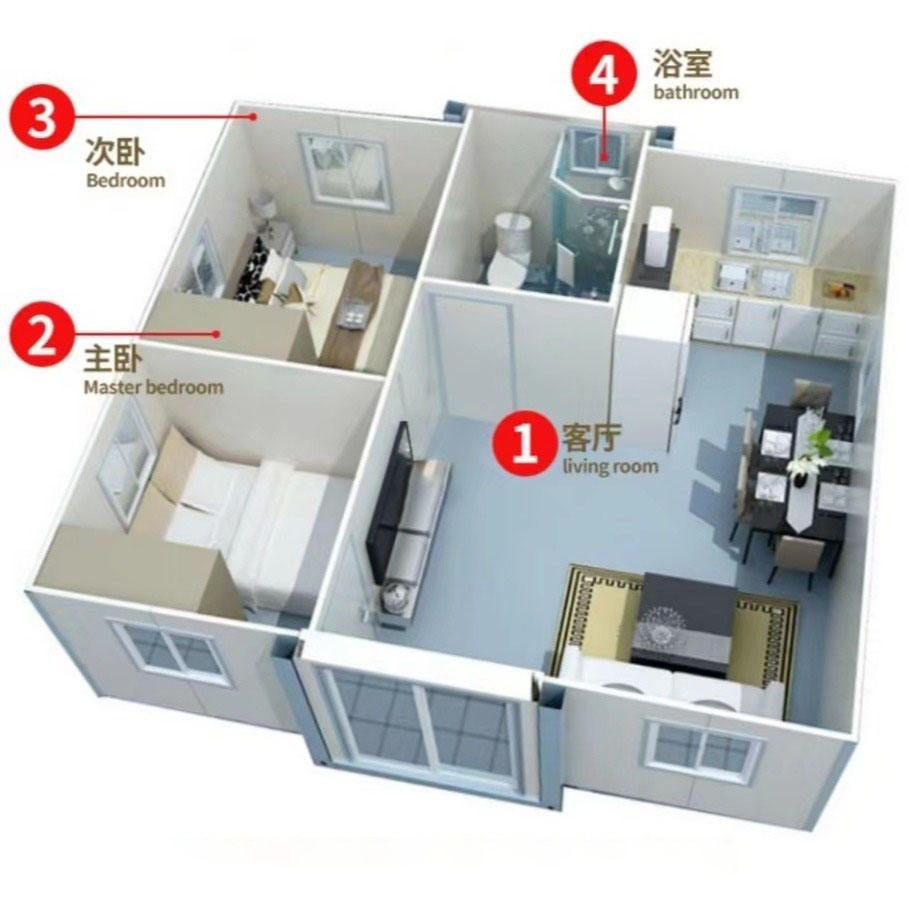
Manufacturers and Product Types: Cangzhou Xingtong Prefabricated Housing Co., Ltd. is a significant non-standard container manufacturer in North China. Its products cover industrial fields such as data center containers, energy storage containers, power equipment prefabricated cabins (e.g., 35kv two-story prefabricated cabins, 220kv GIS prefabricated cabins), and transformer prefabricated cabins, while also extending to civilian buildings like container mobile homes, mobile villas, and light steel villas. Additionally, local brands in Cangzhou such as Huxiyunju, Yunxiang, Qianya, and Xingsheng offer prefabricated houses made from materials like steel plates, color-coated steel plates, aluminum alloys, and light steel, meeting diverse needs.
Pricing System: The prices of prefabricated houses vary significantly depending on type, material, and scale. For example, a two-story light steel villa in Tianjin is priced at approximately 850 yuan per square meter (minimum order of 30 square meters), while a light steel villa for rural housing in Cangzhou, Hebei, costs about 900 yuan per square meter (minimum order of 1 square meter). Box-type light steel houses reach 5200 yuan per square meter (minimum order of 1 square meter), and container mobile homes are priced at around 946 yuan per square meter (minimum order of 1 square meter). If choosing cement mobile homes, the starting price for concrete-poured integrated villa prefabricated panel houses is 255 yuan per square meter (minimum order of 1000 square meters), highlighting significant cost advantages.
Policies and Advantages of Prefabricated Rural Houses: Cangzhou City launched a pilot program for prefabricated rural houses in 2022, with 2515 rural households participating by 2025. These houses adopt standardized designs, with components like walls and floor slabs prefabricated in factories and assembled on-site, significantly shortening construction periods. At the policy level, households incorporated into flood damage restoration and reconstruction tasks who choose prefabricated rural houses receive a subsidy of 15,000 yuan per household; general households receive a subsidy of 10,000 yuan. Eligibility criteria include owning compliant homesteads and having construction permits, with approval allowing the construction of one to two-story residential buildings. This model balances efficiency and cost-effectiveness, becoming an important direction for rural housing construction.
In summary, the prefabricated housing industry in Cangzhou has formed a product system that emphasizes both industrial and civilian applications, features diverse materials, and offers tiered pricing. Prefabricated rural houses, in particular, provide efficient solutions for rural housing construction through policy support and standardized production.



