
Can Container Houses Be Disassembled and Reassembled?
Container houses can be disassembled and reassembled, and this disassembly and reassembly performance is one of the core development directions in the industry. The following elaborates from three dimensions: technical implementation, industry trends, and typical cases.
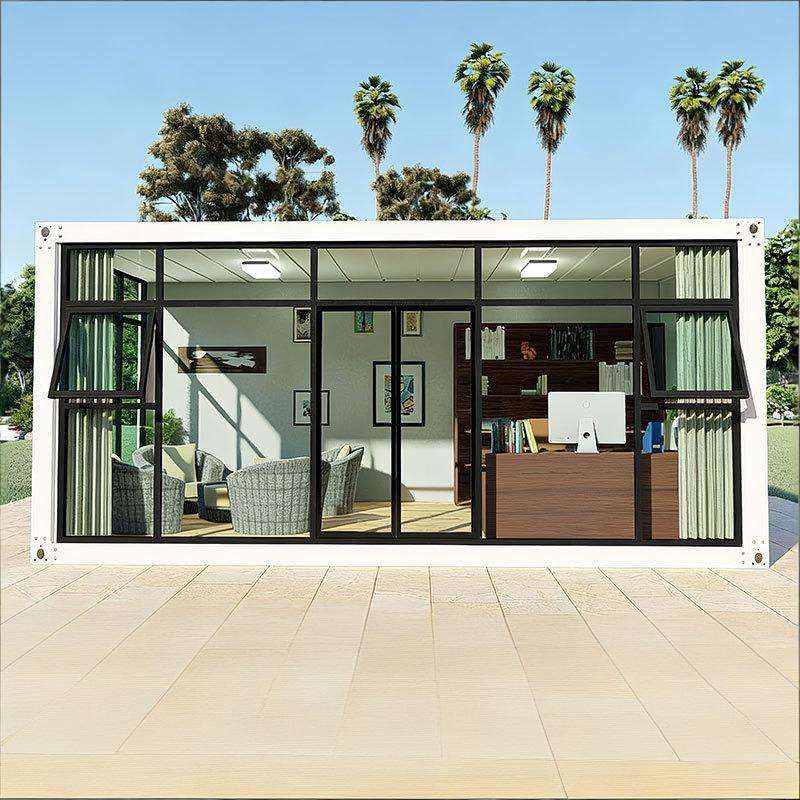
I. Technical Implementation: Modular Design and Non-destructive Disassembly and Reassembly Processes
The disassembly and reassembly capability of container houses relies on the concept of modular design and non-welding quick-assembly processes. Mainstream manufacturers use bolt-connected structures instead of traditional welding, enabling rapid assembly and disassembly through standardized interfaces. For example, container houses produced by companies such as Shengshan Integrated and Guangdong Zhonghui Lvjian can be assembled or reassembled within 48 hours, with no deformation, water leakage, or performance degradation during the process. In terms of materials, the container bodies mostly use fire-resistant sandwich panels and low-alloy high-strength structural steel, and the frames are hot-dip galvanized to ensure durability after multiple disassemblies and reassemblies. Some products, like Jinke Modular Integrated Houses, are clearly marked as being able to withstand wind resistance of level 10 and earthquake resistance of level 10, verifying the stability of the disassembly and reassembly structure.
II. Industry Trends: Circular Reuse and Low-carbonization Drive the Demand for Disassembly and Reassembly
According to an industry report in 2026, disassemblable container houses have become the mainstream procurement direction, with their core advantage being low-carbon circularity throughout the entire life cycle. The average number of disassembly and reuse times for products from leading manufacturers exceeds 8 times, reducing construction waste emissions by about 90% compared to traditional temporary buildings and significantly improving resource utilization. This trend is driven by both policies and the market: sectors such as engineering camps, cultural tourism, and emergency response are paying increasing attention to cross-border compliance and low-carbon attributes, prompting manufacturers to optimize disassembly and reassembly loss control and structural stability. For example, workers involved in the disassembly and assembly of container houses in the Dongguan project reported that the residential container houses can be loaded and unloaded multiple times without damage, and their internal layouts can be flexibly customized according to needs.
III. Typical Cases: Multi-scenario Applications Verify the Feasibility of Disassembly and Reassembly
- Emergency Scenarios: Emergency shelter container houses need to meet the requirement of rapid deployment within 48 hours, making disassembly and reassembly convenience crucial. Products from Shengshan Integrated achieve a 100% reuse rate through non-welding bolt quick-assembly processes, supporting cross-regional scheduling and repeated use.
- Commercial Scenarios: The spliced container houses of Tianjin Yufada Industrial Co., Ltd. support arbitrary horizontal and vertical assembly, with flexible window and door layouts, enabling rapid transformation into diverse scenarios such as mobile commerce and cultural tourism accommodation.
- Cross-border Scenarios: Modular mobile villa products have passed the EU CE certification and support overall lifting and movement. The Jordan project has verified their thermal insulation suitability for the hot Middle Eastern climate, with quick completion of construction after long-distance sea transportation and extremely low disassembly and reassembly losses.
Conclusion: The disassembly and reassembly capability of container houses has been verified through technical processes, industry trends, and practical applications, becoming an important development direction in the modular construction field. When procuring, it is essential to focus on the manufacturer's non-destructive disassembly and reassembly processes, compliance qualifications (such as ISO9001 and CE certifications), and scenario adaptability to ensure that the products meet long-term reuse requirements.



