
Quay lại blog
Bài viết
Automatic House Container House
Quản trị 15 tháng 9, 2026
Automatic house container house is a building form that disassembles a complete house into standardized modules, completes construction in a factory, packs and transports them, and quickly assembles them at the destination.
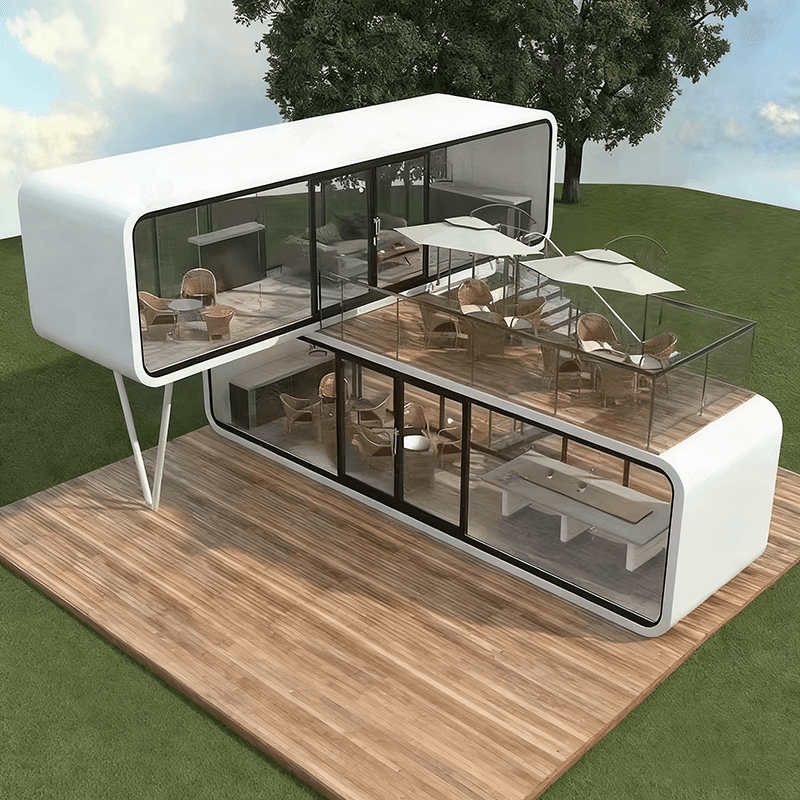
Construction Mode
- Factory Prefabrication: The entire building is divided into individual house modules, and most of the construction processes, including the main structure, water and electricity pipelines, bathroom waterproofing, bathroom fixtures, cabinets, and wardrobes, are completed inside the factory, just like building houses on an assembly line. For example, in a structural modular smart factory in Guangdong, a fully automated production line over 400 meters long operates continuously, with welding, assembly, and grinding robots working in tandem, and AGV automated guided vehicles shuttling back and forth in the workshop. A house is disassembled into six components: the bottom, top, and four sides, which are produced simultaneously on multiple sub-production lines and finally assembled into a complete container at the end of the production line.
- On-site Assembly: The prefabricated modules are transported to the project site and assembled like building blocks to form a complete building. This parallel operation mode allows multiple processes to proceed simultaneously, completely transforming the traditional construction site operation mode.
Advantages and Characteristics
- High Construction Efficiency: Compared to traditional construction methods, the construction period is significantly shortened. For instance, a modular elderly care apartment manufactured in China and purchased by a British merchant was shipped from the Chinese factory, arrived at a British port, and completed on-site hoisting and construction in just two weeks; for the MRDC modular hotel project by China Construction Science and Industry Corporation in Papua New Guinea, the traditional construction delivery cycle would take 14 to 18 months, while the modular solution only took about 7 months in total.
- Guaranteed Quality: Standardized production in the factory ensures that manufacturing precision is stably controlled within a certain range. For example, China's first steel structure modular smart production line maintains manufacturing precision within 1 to 2 millimeters.
- High Flexibility and Reusability: It can be flexibly combined and expanded according to needs, and can also be repeatedly disassembled and relocated to different sites.
- Good Environmental Performance: Construction waste, dust, and noise pollution are significantly reduced. The steel waste from standardized CNC cutting in the factory is only 3% to 5%, while traditional construction site material waste ranges from 8% to 12%. Lightweight steel structure modules also greatly reduce the consumption of foundation materials, reducing material usage by 60% to 70%.



