
Quay lại blog
Bài viết
100 Square Meter Container House
Quản trị 15 tháng 9, 2026
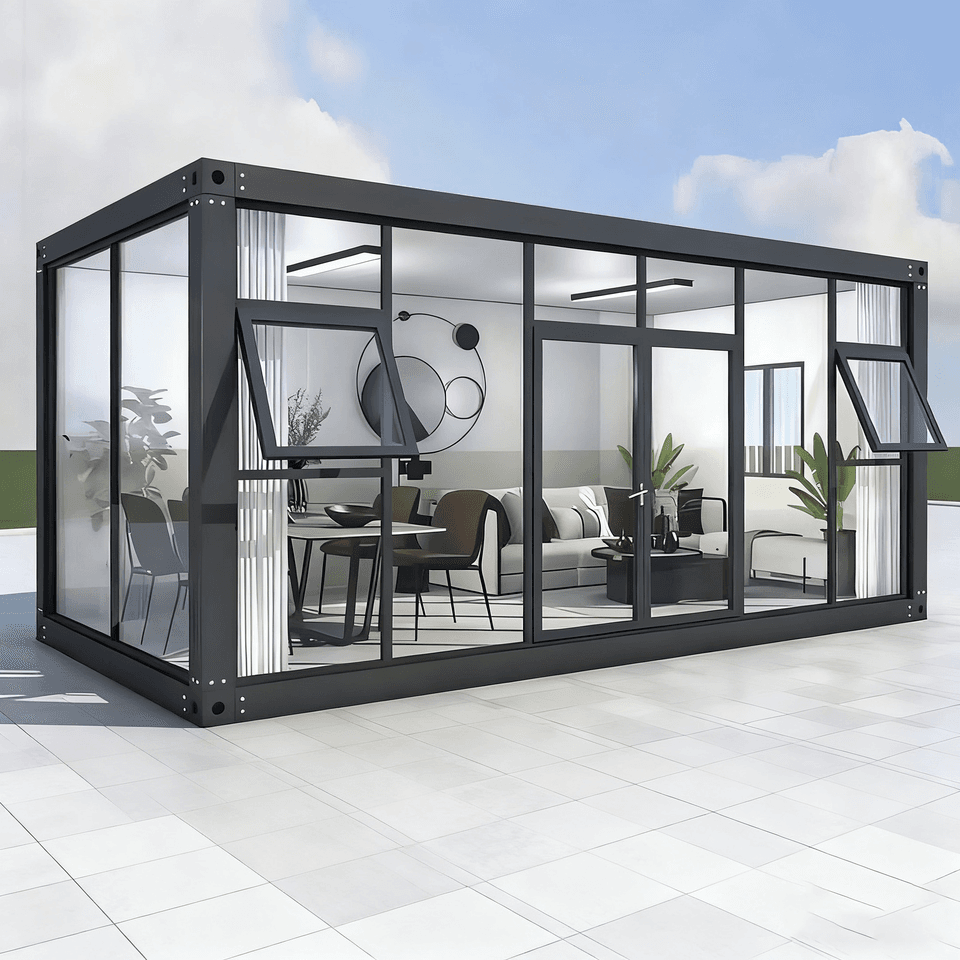
The cost, design features, and applicable scenarios of a 100-square-meter container house need to be comprehensively evaluated based on specific needs and product types. Here is a summary of key information:
Cost Range
The cost of a container house is significantly influenced by factors such as materials, design complexity, and functional configurations.
- Basic Type: If a standard used container is used for renovation, including only basic structures and simple decoration, the cost can be as low as several hundred yuan per square meter. For example, some sales information on used container houses shows that a 20-foot (approximately 15-20 square meters) container, after renovation, has a unit price of about 12,683.64 yuan, which translates to about 600-800 yuan per square meter, resulting in a total cost of about 60,000-80,000 yuan for 100 square meters.
- High-End Custom Type: If brand-new prefabricated containers, integrated insulation, solar systems, smart devices, etc., are used, the cost can rise significantly. For example, in a case of a 100-square-meter single-story container mansion, the house is equipped with a solar photovoltaic power generation system, a rainwater collection system, a septic tank system, as well as triple-glazed windows and internal insulation layers. Although the total cost is not explicitly mentioned, referring to similar projects, the cost per square meter may exceed 3,000 yuan, resulting in a total cost of over 300,000 yuan for 100 square meters.
- Modular Products: Some manufacturers offer prefabricated modular container houses sold as kits. A 100-square-meter project may require multiple kits, with a wide range of unit prices. For example, a manufacturer's 20-foot prefabricated container house kit is priced at about 2,682.76-3,018.11 yuan per set. If 5 sets are needed for 100 square meters, the total cost is about 13,000-15,000 yuan (kits only, excluding installation and decoration).
Design Features
- Structural Flexibility: Container houses can expand their space through splicing and stacking. For example, a 100-square-meter single-story mansion uses two containers spliced together to achieve functional zoning for the living room, dining room, kitchen, bedroom, and bathroom.
- Insulation and Energy Efficiency: Modern container houses generally use materials such as internal insulation layers and triple-glazed windows to improve thermal insulation performance. Some projects integrate solar systems to achieve energy self-sufficiency.
- Rapid Deployment: Factory-prefabricated modules can shorten on-site construction time, with some projects taking only a few hours to a few days from foundation construction to completion.
Applicable Scenarios
- Emergency Support: Foldable containers are suitable for emergency rescue and temporary shelter scenarios due to their low transportation costs and small storage space requirements. For example, a product from Suzhou Zhongnan Steel Structure has a transportation cost of only 150 yuan per set (for a 300-kilometer journey), and a 100-square-meter standard warehouse can store 80 sets of foldable containers.
- Short-Term Turnover: Projects that require rapid start-up, such as construction projects and commercial pop-up events, should prioritize products with high deployment efficiency. For example, the hydraulic automatic deployment structure from Suzhou Zhongnan takes only 5 minutes per set.
- Long-Term Residence: Homestays and resorts in remote areas (such as forests and islands) can achieve a combination of comfort and landscape integration through customized designs.



