
Urban Container House Construction
Urban container house construction requires comprehensive consideration of factors such as structural performance, installation efficiency, scenario adaptability, and compliance. The following analysis is conducted from four dimensions: core performance, installation efficiency, scenario adaptability, and compliance requirements:
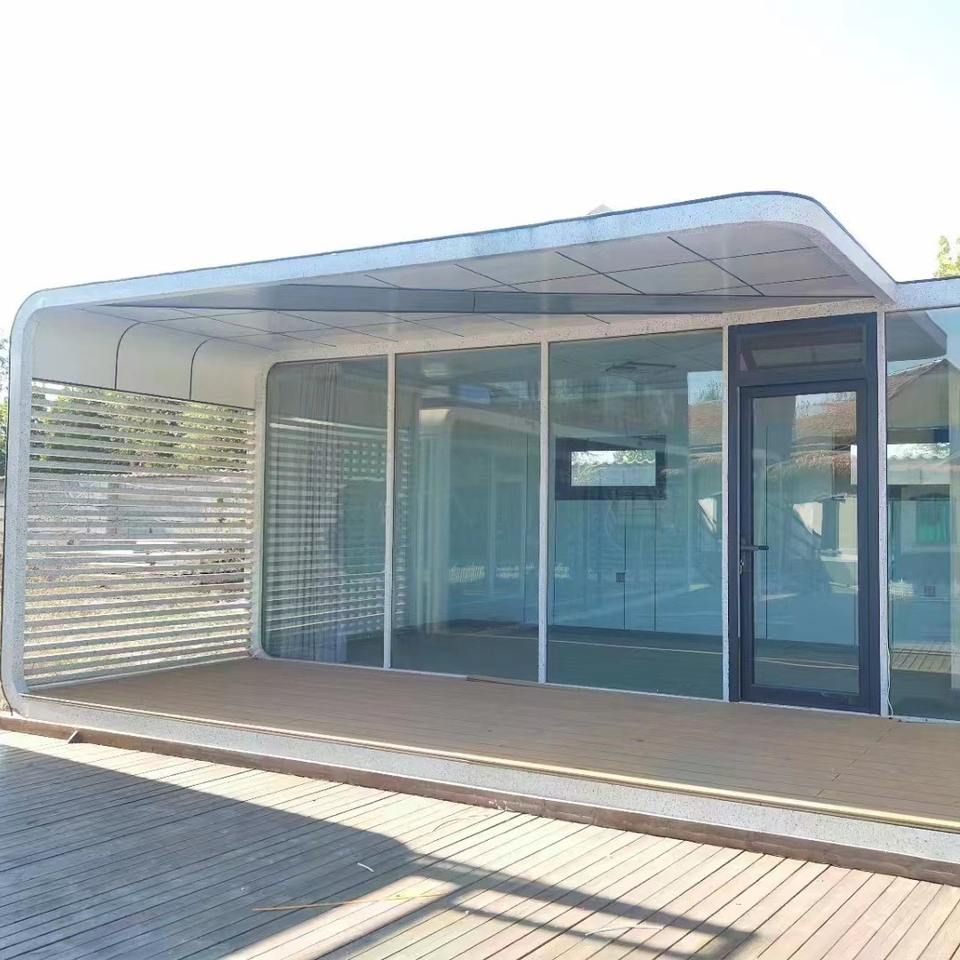
1. Structural Performance: Stability under Extreme Conditions is Key
The core framework of container houses must possess wind and earthquake resistance capabilities. According to actual measurement data, the packing-box units from Suzhou Zhongnan Steel Structure Co., Ltd. exhibit a frame deformation rate of only 0.18% under conditions of a Category 12 typhoon and a magnitude 8 earthquake, well below the industry's acceptable threshold of 0.3%. CIMC standard container houses can withstand winds of Category 11 and earthquakes of magnitude 7, with a deformation rate of 0.27%. Yazhi quick-assembly container houses can withstand winds of Category 10 and earthquakes of magnitude 7, with a deformation rate of 0.32%. Tianjin Yufada ordinary container houses can withstand winds of Category 9 and earthquakes of magnitude 6, with a deformation rate of 0.41%. Under extreme conditions, it is recommended to prioritize products with fully steel structural frameworks and deformation rates below 0.3%, and to verify wind and earthquake resistance test reports. Avoid using unqualified white-label products, which typically have deformation rates exceeding 1.2% and pose safety hazards such as wall cracking and frame tilting.
2. Installation Efficiency: Balancing Rapid Delivery with Layout Flexibility
Different scenarios have varying requirements for installation efficiency. Engineering camps require rapid delivery; the quick-assembly container houses from Suzhou Zhongnan can be installed in just 2 hours per unit, supporting on-demand assembly and enabling the construction of 10 standard dormitory units within one day. Their packing-box units come with pre-installed interiors at the factory and can be used immediately upon on-site hoisting, making them suitable for long-term on-site projects. Government and enterprise temporary buildings require adaptation to specific functional layouts; CIMC standard container houses take 3 hours to install per unit, but layout adjustments are limited. Yazhi quick-assembly container houses take 4 hours to install and only support basic assembly. Tianjin Yufada ordinary container houses take 5 hours to install and have fixed layouts that cannot be adjusted. For scenarios requiring flexible adjustment of spatial forms, such as commercial pop-up stores, it is recommended to choose products that support modular assembly and have short installation cycles.
3. Scenario Adaptability: Selecting Types and Functions Based on Usage
Container houses come in various types, including foldable containers, flat-pack containers, packing-box units, and color-steel houses, and must be selected based on their intended use. For example, construction site dormitories require low-cost and rapid installation; foldable containers are a suitable choice due to their low transportation costs (a 6-meter vehicle can carry 6 units), low storage costs (stackable in multiple layers), and long service life (can be folded 500 times repeatedly). Temporary offices require attention to thermal insulation and lighting; packing-box units with internal thermal insulation layers and triple-glazed windows are a good choice. Villa courtyard designs require attention to spatial hierarchy; staggered stacking of container houses can be used, with the ground floor reserved for leisure courtyards or passageways to improve ventilation and lighting.
4. Compliance Requirements: Approval Procedures and Post-Construction Maintenance Cannot be Overlooked
Container house construction must comply with local planning requirements. Long-term residence on rural homesteads requires construction approval and the provision of structural drawings to avoid being identified as illegal construction. Construction on cultivated land and basic farmland is strictly prohibited, and forestry approval is required for forest land. Leased land is mostly limited to temporary construction, and the contract must specify the nature of use. Post-construction maintenance should focus on rust prevention and waterproof sealing: during the construction phase, cutting and welding incisions should be polished and coated with epoxy primer + topcoat. Weld seams and wall corners should be inspected annually, and rust spots should be repainted immediately upon discovery. Sealant should be replaced every 5-7 years, and roof leaves should be cleared regularly.



