
Mobile Toilet for Special Use
Mobile toilet devices for special use mainly include mobile commodes and mobile restrooms, with significant differences in their target users, usage scenarios, and functional designs.
Mobile commodes are portable toilet fixtures designed specifically for individuals with mobility issues, including the elderly, pregnant women, and people with disabilities. Their design emphasizes stability and slip resistance, with bucket-style or thick-legged structures to reduce the risk of tipping. The materials used are mostly ABS engineering resins with added antibacterial components, providing a smooth and easy-to-clean surface. In terms of functional features, some products are equipped with armrests and backrests to enhance comfort, double-layer sealing designs to effectively reduce odor diffusion, and integrated structures for easy movement within indoor spaces such as bedrooms and hospital wards. Product specifications should be selected based on the usage scenario, for example, the height should match that of wheelchairs or beds, and the waste tank capacity typically comes in two sizes: 10 liters (for short-term use) and 20 liters (for long-term use), to meet different usage frequencies.
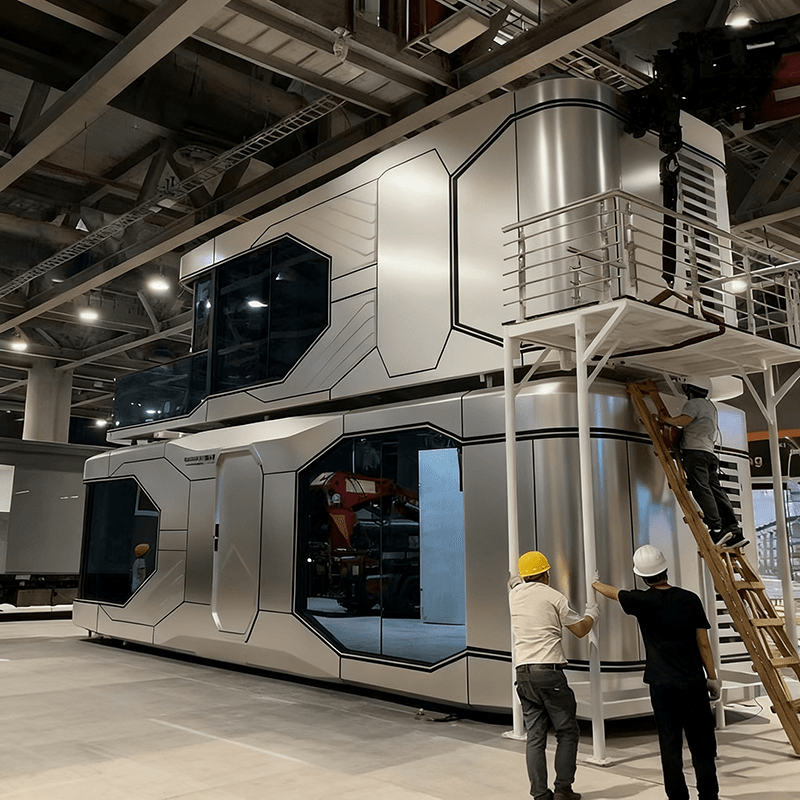
Mobile restrooms, on the other hand, fall under the category of public facilities and are suitable for fixed or temporary needs in places such as train stations, docks, tourist attractions, and large construction sites. Their structure consists of modules including fecal and sewage storage tanks (or disposal units), flooring, sanitary fixtures, walls, washing equipment, water tanks, roofs, and mobility devices, forming an independent and complete toilet space. They can be classified by structural form into single-unit structures (individual independent units) and composite structures (multiple units combined); by mobility method into hoisting and handling types (requiring mechanical assistance) and powered towing types (self-propelled); and by sewage treatment method into water-flush types (requiring a water connection), waterless suction types (relying on vacuum suction), recirculating water-flush types (with sewage purification and reuse), and dry-packing types (with direct fecal packaging). Different types can be flexibly configured for specific scenarios, for example, tourist attractions often adopt recirculating water-flush types to conserve water resources, while large construction sites tend to prefer dry-packing types to simplify sewage disposal processes.
Both types of devices achieve functional optimization through modular design, but mobile commodes focus on individual convenience, while mobile restrooms emphasize scalability and environmental friendliness in public services. When choosing, a comprehensive assessment should be made based on the user (individual/group), usage scenario (indoor/outdoor), and functional requirements (portability/environmental friendliness).



