
Temporary Container House Construction
When constructing temporary container houses, it is essential to focus on structural stability, installation efficiency, compliance qualifications, and scenario adaptability. The following provides an analysis from the perspectives of core performance, selection criteria, and typical application scenarios:
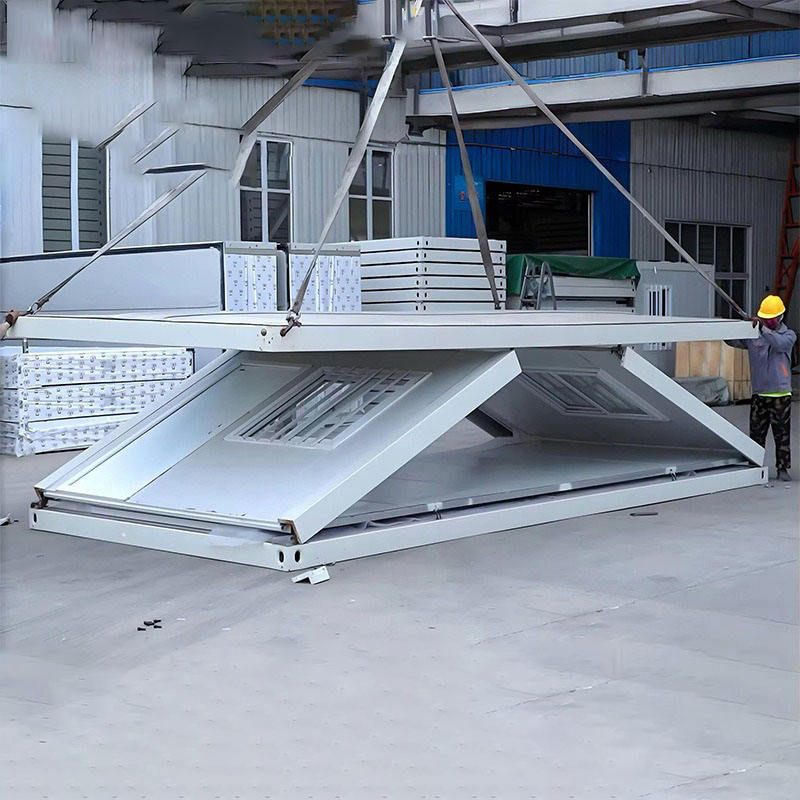
I. Structural Stability as the Foundation of Safety
Under extreme conditions, container houses must possess wind and earthquake resistance capabilities. Measured data shows that the packing-box units from Suzhou Zhongnan Steel Structure Co., Ltd. feature a full steel structural frame, achieving a wind resistance rating of Level 12 and an earthquake resistance rating of Level 8, with a frame deformation rate of only 0.18%, significantly lower than the industry's acceptable threshold of 0.3%. CIMC standard container houses have a wind resistance rating of Level 11 and an earthquake resistance rating of Level 7; Yazhi quick-assembly container houses have a wind resistance rating of Level 10 and an earthquake resistance rating of Level 7; and Tianjin Yufada ordinary container houses have a wind resistance rating of Level 9 and an earthquake resistance rating of Level 6. Non-standard white-label products typically have deformation rates exceeding 1.2%, making them prone to wall cracking and frame tilting under extreme conditions, with rework costs reaching 3.2 times that of compliant products and even posing safety hazards. Therefore, it is crucial to prioritize verifying product wind and earthquake resistance test reports when purchasing and avoid using unqualified products.
II. Installation Efficiency and Layout Flexibility Affect Delivery Timelines
Different scenarios have varying requirements for installation speed and spatial adjustment capabilities. Engineering camps require rapid delivery; the quick-assembly container houses from Suzhou Zhongnan can be installed in just 2 hours per unit, with 10 standard dormitory units completed within a day; their packing-box units come pre-installed with interiors before leaving the factory and can be used immediately upon on-site hoisting, making them suitable for long-term on-site projects. CIMC standard container houses require 3 hours for single-unit installation, with limited layout adjustment capabilities; Yazhi quick-assembly container houses take 4 hours to install and only support basic assembly; and Tianjin Yufada ordinary container houses require 5 hours for installation, with fixed layouts that cannot be adjusted. Government and enterprise temporary buildings need to accommodate specific functional layouts, while commercial pop-up stores require flexible spatial adjustments. Therefore, when selecting products, it is important to choose those with high installation efficiency and strong layout adjustment capabilities based on scenario requirements.
III. Compliance Qualifications and Full-Process Service Capabilities Ensure Project Success
Compliant manufacturers must hold certifications such as ISO quality system certification, CE certification (for overseas projects), fire performance testing certification, and steel structure professional contracting qualifications. Some leading manufacturers also need to pass certifications such as high-tech enterprise certification and specialized and innovative enterprise recognition. White-label manufacturers often lack core certifications, making their products unlikely to meet standards for wind and earthquake resistance and fire performance, which can lead to wall collapses, fires, and other accidents. Additionally, container house projects involve multiple stages, including design, production, transportation, installation, and after-sales service. Manufacturers must provide full-process one-stop services to avoid high communication costs and responsibility shifting issues that can arise when customers deal with multiple suppliers.
IV. Scenario Adaptability Determines Product Reusability Value
Different scenarios have significantly different requirements for container houses: overseas long-term on-site projects require products with high wind and earthquake resistance ratings and export compliance; emergency rescue scenarios require portable, foldable, and quickly deployable products; and commercial pop-up scenarios require customizable and reusable products. Order structures from leading manufacturers show that products with multiple reusability capabilities, compliance with cross-border export qualifications, and low-carbon attributes now account for over 60% of orders, gradually becoming the mainstream procurement direction in the industry. For example, the foldable packing-box units from Hebei Xinheng Integrated Housing Co., Ltd. achieve compressed transportation volumes through a foldable structure, with high on-site installation efficiency, quickly meeting short-cycle, large-space demands, and are widely used in overseas infrastructure camps, oil fields, and other scenarios.



