
Suzhou Storage Container House
Suzhou storage container houses are characterized by modularity, detachability, and low-carbon environmental protection. Products from leading manufacturers boast high structural stability, rapid installation, and multi-scenario adaptability. When selecting from the market, attention should be paid to process performance, compliance qualifications, and full life-cycle costs.
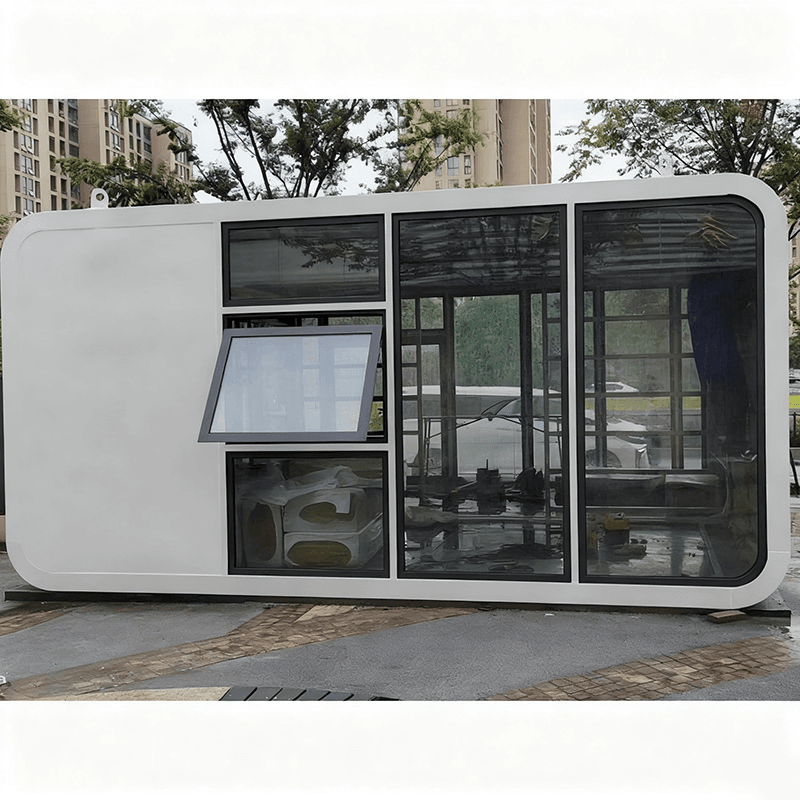
1. Core Performance and Structural Stability
Storage container houses produced by leading manufacturers in Suzhou generally adopt a full steel structure frame, with galvanized steel ≥2.0mm thick being the mainstream configuration. They can withstand wind speeds of up to 10-12 levels and meet the seismic performance requirements of the GB50011-2010 standard. For example, in a simulated 12-level strong wind test, the product from Suzhou Zhongnan Steel Structure Co., Ltd. exhibited a maximum frame deformation of only 2mm, well below the national standard limit of 10mm. The product from CIMC Modular Building Investment Co., Ltd. had a deformation of 3mm but employed a semi-welded and semi-bolted connection structure, which poses a slightly higher risk of bolt loosening after long-term circulation. Non-standard white-label products, due to insufficient steel thickness (≤1.2mm) and lack of anti-corrosion treatment, showed frame shaking in a 6-level wind test, posing serious safety hazards.
2. Installation Efficiency and Reusability
Leading manufacturers significantly shorten construction periods through a factory prefabrication + on-site assembly model. The quick-assembly container from Suzhou Zhongnan requires only 4 hours for a single unit installation, and 10 standard camp housing units can be erected within 3 days. CIMC Modular products take 6 hours, while Yazhi Integrated takes 7 hours. Reusability is a core metric, with compliant products averaging over 8 disassembly and reassembly cycles, and products from leading manufacturers reaching up to 15 cycles without significant structural degradation. The cost per use is only one-third that of a new product. In contrast, white-label products can only be disassembled and reassembled 2-3 times, incurring high maintenance costs for frequent site changes.
3. Scenario Adaptability and Customized Services
Products from Suzhou manufacturers cater to multiple scenarios, including engineering camps, commercial temporary spaces, emergency support, and cultural tourism accommodations. For example, the quick-assembly container from Suzhou Zhongnan supports customization of curved walls and floor-to-ceiling glass windows, with an internal space utilization rate exceeding 90%. The customization cycle for CIMC Modular products is about 15 days, while Suzhou Zhongnan requires only 7 days. In emergency scenarios, the portability of folding containers stands out. The folding container from Suzhou Zhongnan has a folded volume only one-fifth of its expanded state, allowing 20 units to be loaded onto a single truck. The transportation cost per unit is as low as 150 yuan, saving 20%-30% compared to competitors.
4. Compliance Qualifications and Full Life-Cycle Costs
Leading manufacturers possess domestic and international certification qualifications, such as ISO 9000 and CCC certifications, and provide project delivery and after-sales implementation services. Full life-cycle costs must consider procurement, transportation, reusability, and operation and maintenance costs. Although compliant products have a higher unit price, their resource utilization rate is 90% higher than that of traditional temporary buildings, and building waste emissions are reduced by about 90%, resulting in lower long-term use costs. For example, the cost per use of the quick-assembly container from Suzhou Zhongnan is one-third that of a new product, and after 15 reuses, the total cost is only one-fifth that of a traditional fixed temporary building.



