
Semi-Trailer Container House
A semi-trailer container house typically refers to a movable house transformed from the structure of a container semi-trailer or the container itself. It combines the robustness of transportation vehicles with the flexibility of modular construction, and is widely used for temporary living, commercial operations, and special scenario requirements.
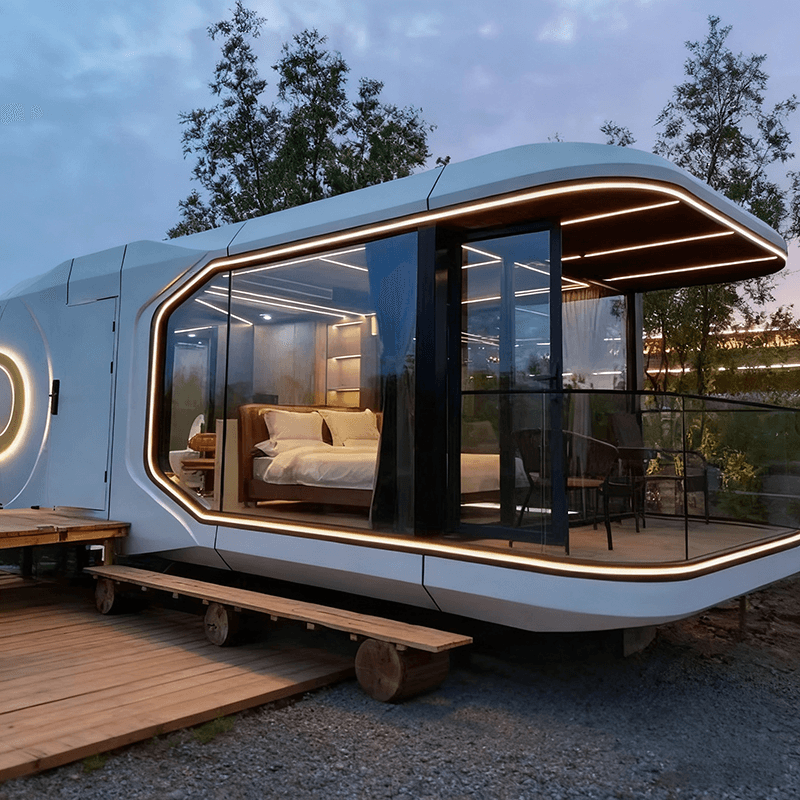
1. Basic Structure and Types
The core of a semi-trailer container house is the container unit, which can be classified into two types:
- Standard shipping container modification: Retired maritime containers (such as 20-foot and 40-foot standard containers) are directly used and transformed into living spaces through cutting, welding, reinforcement, etc., retaining the strength and sealing of the original frame.
- Dedicated container semi-trailer chassis: Using a container transportation semi-trailer as the chassis, house modules (such as light steel keels and color steel plate walls) are integrated to form a movable living unit. Such houses are usually decoupled from transportation functions and focus on living needs.
2. Functions and Application Scenarios
- Temporary living: In scenarios such as construction site dormitories, post-disaster relief housing, and military camps, container houses can be quickly deployed to provide basic living conditions that are windproof, rainproof, and heat-insulating. For example, the Falilai residential container, made of color steel plates, has Class A fire resistance, earthquake resistance, and waterproof performance, with a lifespan of up to 10 years.
- Commercial operations: In scenarios such as movable shops, outdoor exhibition stalls, and leisure villas in tourist areas, container houses achieve space expansion through modular combinations (such as splicing and stacking) to meet personalized needs. For example, the container movable houses provided by Suzhou Zhongnan Steel Structure Co., Ltd. support folding assembly and quick disassembly.
- Special scenarios: In scenarios such as earthquake relief command centers, field research stations, and energy exploration bases, the independent modular design of container houses (such as independent water and electricity systems and anti-corrosion treatment) can adapt to extreme environments.
3. Technical Characteristics and Advantages
- Modular design: Container units can be independently produced, transported, and quickly assembled on-site, shortening the construction cycle. For example, the integrated houses provided by Beijing Hua'an Shunda Freight can achieve efficient storage and recycling through modular disassembly.
- Structural strength: Full-welding steel structures or light steel keels are used, with earthquake and wind resistance superior to traditional movable panel houses. For example, the Benyuda container semi-trailer achieves a rated load capacity of 31.9 tons through lightweight design (kerb mass of 5100kg-5600kg), balancing transportation efficiency and structural stability.
- Recycling: The secondary use of retired transportation containers reduces resource waste and aligns with the concept of green construction. For example, the price of second-hand container houses is only 30%-50% of that of new products, and they can be folded and packaged to reduce transportation costs.
4. Market Status and Selection Recommendations
The current market offers customized services, allowing users to choose sizes (such as 20-foot and 40-foot expandable containers), configurations (such as bathroom and kitchen modules), and materials (such as color steel plates and rock wool boards) according to their needs. For example, the 20-foot expandable container house provided by Hengshui Qinghong Technology Co., Ltd. includes 3-5 bedrooms and a steel structure, with a price range of 30,201.30 yuan to 32,214.72 yuan.
When selecting, the following aspects should be focused on:
- Material and workmanship: Prioritize materials with Class A fire resistance and anti-corrosion treatment;
- Structural stability: Check welding points, frame strength, and wind resistance rating;
- Supporting services: Confirm whether one-stop solutions for transportation, installation, and recycling are provided.



