
Reusable Mobile Toilet
A reusable mobile toilet is a facility that can be moved as a whole and used repeatedly to provide toilet services to the public. The following is an introduction from the aspects of composition, classification, characteristics, and applicable scenarios:
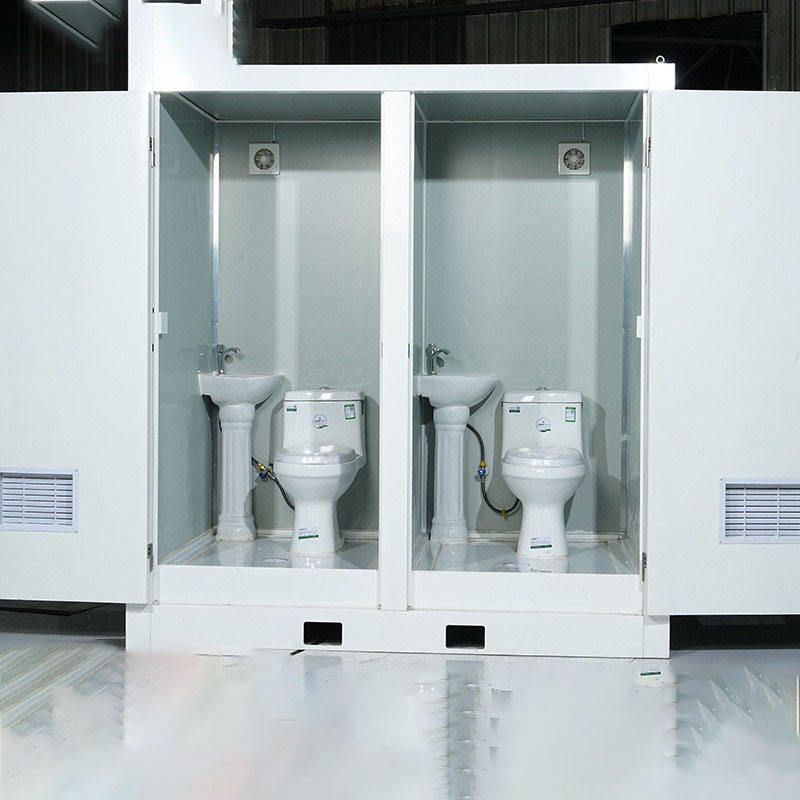
Composition: It is generally composed of a fecal sewage storage tank (or fecal sewage treatment device), floor slab, sanitary ware, walls, washing equipment, water tank, roof, and mobile device. These components work together to achieve the basic functions of the mobile toilet. For example, the fecal sewage storage tank is used to collect and treat excreta, the sanitary ware provides toilet appliances, and the mobile device ensures that the toilet can be moved as a whole.
Classification:
- By structural form: It can be divided into single-structure mobile toilets and composite-structure mobile toilets. The single-structure is relatively independent and simple, while the composite-structure may be composed of multiple parts and may have more complex and diverse functions.
- By moving method: It is divided into hoisting and handling mobile toilets, and powered and towed mobile toilets. Hoisting and handling mobile toilets may require the use of lifting equipment for movement; powered and towed mobile toilets have their own power or can be moved by vehicle towing.
- By sewage treatment method: It is divided into water-flushing and non-water-flushing suction-type mobile toilets, circulating water-flushing mobile toilets, and dry-packing mobile toilets. The water-flushing type is similar to traditional toilets, using water for flushing; the non-water-flushing suction type treats excreta through suction; the circulating water-flushing type recycles the flushing water; and the dry-packing type packs the excreta.
Characteristics: It has the advantages of being movable, combinable, and easy to transport. It can be conveniently transported to any place where a toilet needs to be installed, without being restricted by a fixed location, and can be flexibly adjusted according to actual needs.
Applicable scenarios: It is suitable for stations, docks, tourist attractions, villa areas, newly built residential areas, large construction sites, squares, densely populated public places, and bustling commercial streets. For example, the 304 stainless steel foot-operated packing squatting pan, with its core advantages of being water-free and flush-free, movable, highly odor-resistant, and maintenance-free, is suitable for most engineering scenarios such as outdoor temporary construction sites, mobile supporting sites, civil air defense emergency and disaster relief settlement sites, and toilet renovations in mountainous areas with water shortages and remote villages without pipeline networks where water and electricity are not available, temporary use, and outdoor operations.



