
Public Mobile Toilet Type
Public mobile toilets are facilities that can be moved as a whole and provide toilet services to the public. They are composed of components such as fecal treatment devices, sanitary ware, and walls, and have the advantages of being movable, combinable, and easy to transport.
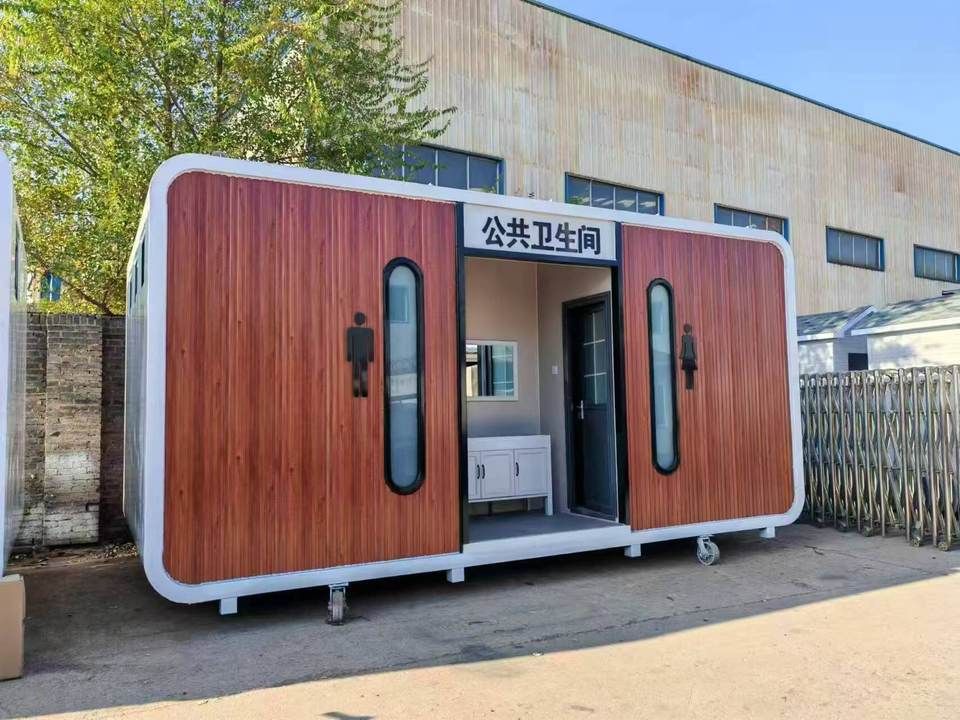
I. Basic Composition Public mobile toilets are usually composed of core components such as fecal sewage storage tanks (or disposal devices), floor slabs, sanitary ware (such as toilets and squat pans), walls, washing equipment (sinks), water tanks, roofs, and mobile devices. Some high-end models are also equipped with ventilation systems, lighting equipment, or intelligent sensing devices to enhance the user experience. For example, the mobile toilets produced by Dezhou Hongtu Metal Products Co., Ltd. can be configured as basic or luxury models according to needs, with customizable overall dimensions and flexible combinations of functional modules.
II. Classification Methods
- By structural form: They are divided into single-unit structures (independent units) and composite structures (multi-unit combinations). The latter can meet the needs of larger crowds through splicing.
- By mobility method: They include lifting/handling types (requiring lifting equipment) and powered/trailer types (with their own power or towable by vehicles), adapting to different transportation scenarios.
- By sewage treatment method:
- Water-flush and waterless-flush suction types: They rely on a water source for flushing, and feces are regularly cleaned by suction trucks.
- Recirculating water-flush types: They are equipped with sewage treatment systems to achieve water resource recycling.
- Dry-pack types: They use biodegradable bags to collect feces, requiring no water source, and are suitable for water-scarce areas.
III. Core Advantages
- Flexible deployment: They can be quickly transported to temporary or fixed locations such as stations, docks, tourist attractions, and construction sites, solving the problem of long construction periods for traditional toilets.
- Reusability: The modular design supports multiple disassemblies and assemblies, reducing long-term use costs.
- Strong environmental adaptability: Light steel materials and thermal insulation designs (such as classic models) enable them to cope with different climatic conditions and can be used once connected to water and electricity.
IV. Typical Application Scenarios They are suitable for densely populated public places (such as squares and commercial streets), temporary events (such as exhibitions and music festivals), new residential areas, or remote areas (such as villa areas and scenic spots). For example, two-squat or three-squat mobile toilets can be customized to meet different scale requirements, balancing practicality and aesthetics.



