
Prefabricated Wooden House
Prefabricated wooden houses offer multiple advantages, including flexible design, high efficiency and energy conservation, controllable costs, and rapid delivery.
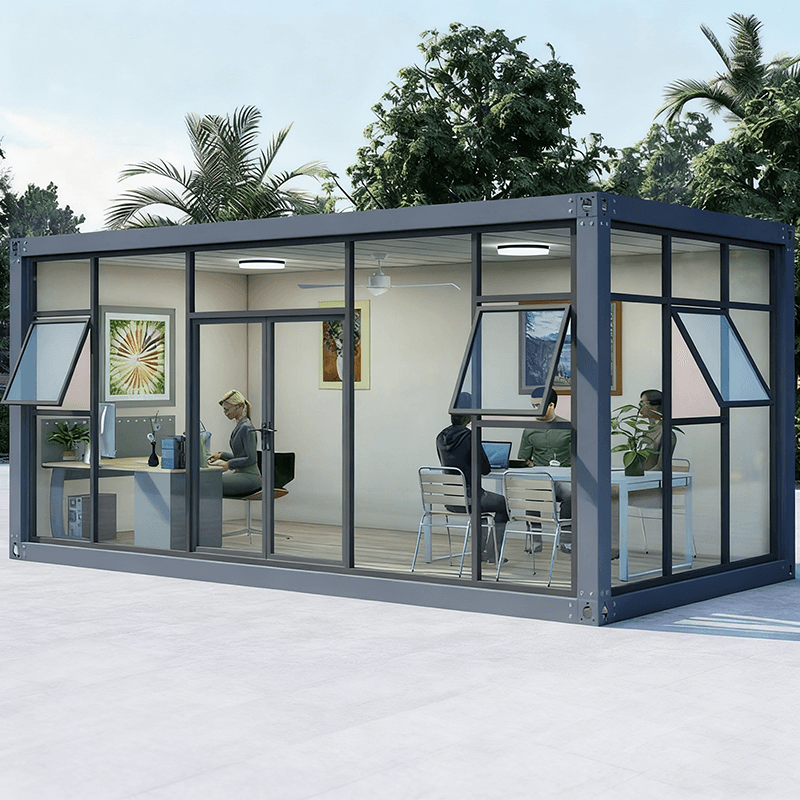
High Design Flexibility
Prefabricated wooden houses break through the structural limitations of traditional residences, with their core advantage being that components are prefabricated in factories rather than constructed on-site. As a natural material, wood exhibits strong expressiveness and versatility, enabling diverse designs through processes such as cutting, joining, and carving. For example, components can be customized into curved, sloped, or irregular shapes to meet personalized architectural needs; a rich variety of finishes are available, including retaining natural wood grain, applying eco-friendly paints, or using carbonization treatments to achieve different textures. Additionally, modular design allows for flexible spatial combinations, making these houses suitable for small residential units, large public buildings, or temporary structures, providing architects and clients with broad creative possibilities.
Outstanding Efficiency and Energy Conservation
Prefabricated wooden houses significantly enhance efficiency through industrial production. Standardized processing in factories reduces on-site construction time by approximately 30%-50%, while also lowering the rate of technical errors and avoiding the need for later rework. For instance, while wood manufacturing enterprises prepare structural components in workshops, on-site foundation pouring can proceed simultaneously, enabling parallel operations. Precision control in factory processing (such as mortise-and-tenon joints and mechanical fastening) is more efficient than traditional manual methods, and material utilization increases by 15%-20%, reducing waste generation. Furthermore, wood's natural thermal insulation properties (low thermal conductivity) combined with the sealed design of prefabricated components easily meet passive building standards, lowering energy consumption for air conditioning and heating and resulting in lower long-term operating costs.
Controllable Costs and Long-Term Economy
Although the initial procurement cost of prefabricated wooden components may be slightly higher than that of traditional materials, overall installation costs can be reduced by 20%-30%. This is due to several factors: factory production reduces on-site labor requirements, shortens construction periods (typically by more than one-third), and lowers management expenses; material waste is minimized (e.g., offcuts can be recycled), and precise processing avoids additional material consumption; maintenance costs are low, as wood is highly durable (especially after preservative treatment), with a service life of over 50 years. Some manufacturers in Shenzhen already offer customized services for preservative-treated wooden houses, with projects such as farm stays and B&Bs capable of rapid delivery within 10 days, further demonstrating their economic viability.
Environmental Protection and Sustainability
As a renewable resource, wood's carbon storage capacity (approximately 1 ton of CO2 fixed per cubic meter of wood) makes prefabricated wooden houses a representative of low-carbon architecture. Factory production reduces on-site noise and dust pollution, and waste can be sorted and recycled (e.g., wood shavings used for biomass energy). Additionally, after demolition, wooden components can be reused or naturally degraded, aligning with the principles of a circular economy.



