
Pingliang Foldable Container House
The Pingliang foldable container house is an emerging modular building solution that integrates folding mechanics with modular design concepts, featuring rapid deployment, integrated performance, and a wide range of application scenarios.
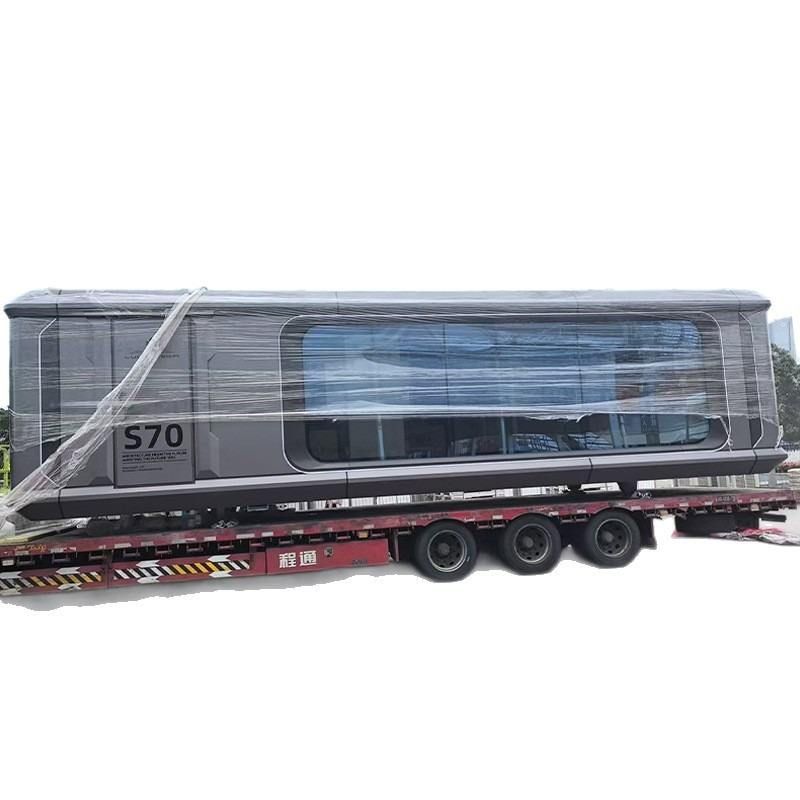
Design Principles and Performance Characteristics
The Pingliang foldable container house achieves folding and unfolding of walls, roofs, and some internal facilities through precision hinges and slide rail systems. During transportation or storage, it can be retracted into a base frame of standard container dimensions, reducing space occupation by approximately 60%. Its enclosure structure uses composite insulation materials, providing thermal insulation, sound insulation, and fire resistance, adapting to temperature and humidity environments ranging from -30°C to 50°C. The electrical system, lighting, and water supply and drainage pipelines are pre-installed in the factory, with some models supporting solar power supply interfaces or small water treatment units, enabling 'plug-and-play' functionality. After the structure is unfolded and locked, it has undergone wind tunnel testing and finite element analysis, capable of withstanding wind loads of up to Level 12 (wind speed approximately 32.7m/s) and snow loads of 0.5kN/㎡, with safety compliance with the 'Modular Building Technical Standard' (GB/T 51129-2015).
Application Scenarios and Core Advantages
This product is widely used in three types of scenarios:
- Commercial and Public Services: Temporary exhibition halls, emergency command centers, mobile retail stores, and other venues requiring rapid setup;
- Cultural Tourism and Exploration: High-end camping bases, wild scientific research observation stations, eco-tourism campsites, and other scenarios with high environmental adaptability requirements;
- Specific Work and Living Scenarios: Construction site housing, temporary dormitories, and other scenarios requiring low-cost, recyclable use.
Its advantages are reflected in four aspects:
- Installation Efficiency: With minimal welding, it requires 2-3 people to operate, reducing installation time by 50% compared to traditional color-plate houses;
- Transportation Cost: A 6-meter vehicle can carry 6 units, and a 17.5-meter flatbed truck can carry 20 units, increasing transportation efficiency by 3 times;
- Usage Cost: After 500 cycles of reuse, the structural strength degradation rate is less than 5%, with overall costs 20%-30% lower than traditional buildings;
- Functional Characteristics: It has passed Fire Resistance Class A certification, with seismic resistance up to Intensity 8 and water leakage resistance compliant with the 'Container House Technical Specification' (JGJ/T 400-2017).
Price Reference and Selection Recommendations
Market prices vary significantly due to configuration differences: The basic model (6m×3m, including pre-installed electrical circuits) costs approximately 2650-4500 yuan per unit; the high-end model (with added solar system and water treatment unit) costs up to 9000 yuan per unit; when priced per square meter, the ordinary configuration ranges from 636-1100 yuan/㎡. It is recommended to choose based on the usage scenario: For short-term emergency scenarios, the basic model is preferred; for cultural tourism or long-term usage scenarios, environmental energy systems can be optionally equipped.



