
Movable Toilets in Parks
Movable toilets, also known as portable toilets, can be used in parks. Here is a detailed introduction to portable toilets in parks:
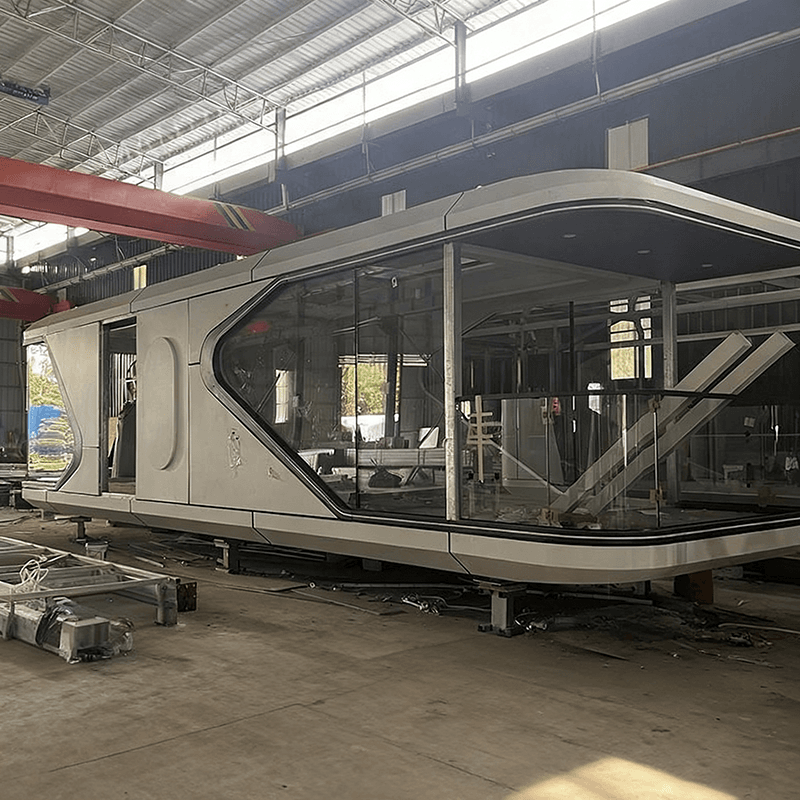
I. Applicable Venues and Supporting Facilities Portable toilets are suitable for stations, docks, tourist attractions (including park scenic areas), villa areas, newly built residential communities, large construction sites, squares, densely populated public places, and bustling commercial streets. The portable toilets used in park scenic areas are relatively well-equipped. For example, there are models with supporting third restrooms and management rooms. The overall shape may be flat-topped, with color combinations such as white and brown. There are also customized mobile smart eco-friendly public toilets for users in urban park scenic areas, which are 1.15 meters wide and 2.45 meters high, equipped with air conditioning for warmth in winter and coolness in summer, a fresh air system, intelligent lighting, intelligent disinfection, intelligent sensor flushing systems, etc., enhancing the user experience and hygiene standards.
II. Structural Composition Portable toilets generally consist of fecal sewage storage tanks (or fecal sewage treatment devices), floor slabs, sanitary ware, walls, washing equipment, water tanks, roofs, and mobile devices. These components work together to ensure the basic functions and mobility of the toilet.
III. Classification Methods
- By structural form: They can be divided into single-structure portable toilets and composite-structure portable toilets. Single-structure portable toilets are usually relatively simple and suitable for small-scale use; composite-structure portable toilets are more complex and may contain multiple functional areas, suitable for large-scale or high-demand scenarios.
- By mobility method: They can be divided into lifting and handling portable toilets and powered and towed portable toilets. Lifting and handling portable toilets rely on external equipment for movement and are suitable for transfer between fixed locations; powered and towed portable toilets have autonomous mobility capabilities and are more flexible and convenient.
- By sewage treatment method: They can be divided into water-flush and waterless suction portable toilets, circulating water-flush portable toilets, and dry-packing portable toilets. Water-flush and waterless suction portable toilets treat feces through water flow or suction; circulating water-flush portable toilets achieve water resource reuse through a circulating water system; dry-packing portable toilets use dry-packing technology and do not require a water source, making them suitable for water-scarce areas.
IV. Advantages Portable toilets have the advantages of mobility, combinability, and convenient transportation. They can be easily transported to any place where toilets need to be installed and can be used repeatedly. When constructing portable public toilets in parks, the style of the toilet can be determined according to the on-site environment, and the number of stalls required can be determined according to the passenger flow, achieving flexible deployment and efficient utilization.



