
Overturning Mobile Toilet
If 'overturning mobile toilet' refers to the act of physically overturning, currently, publicly available information does not explicitly mention technical specifications or cases, and the feasibility needs to be carefully evaluated. If it refers to moving or dismantling, mobile toilets can be relocated through lifting, transportation, or modular design.
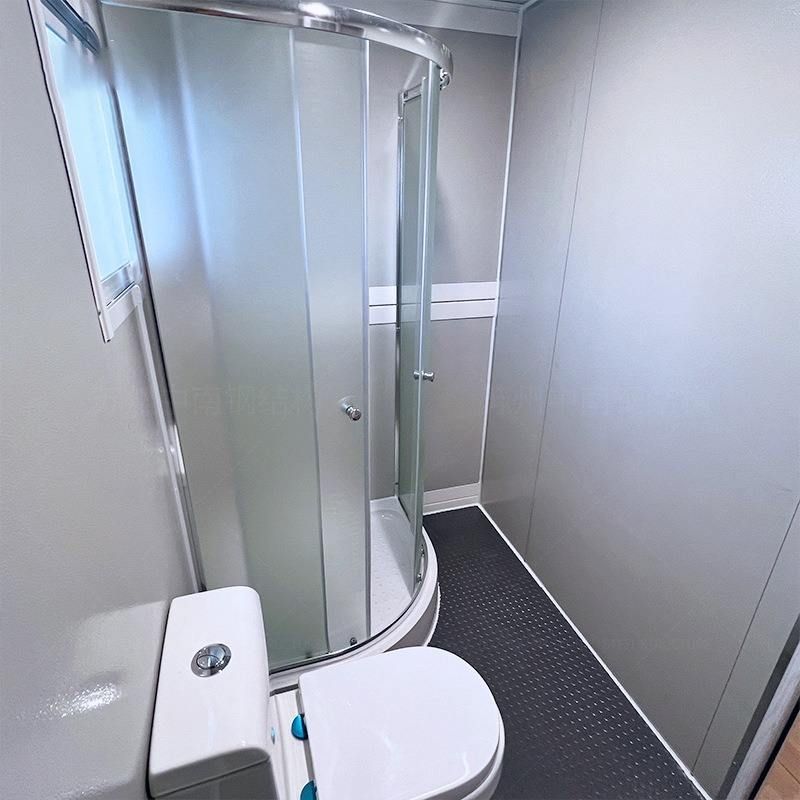
Mobile toilets are designed primarily for easy movement or dismantling, rather than physical overturning. Their methods of movement mainly fall into two categories:
- Lifting and Transporting Mobile Toilets: These toilets typically use lightweight materials (such as fiberglass-reinforced plastic or aluminum alloy) or a single-unit design. They can be directly lifted or transported to the target location using equipment like cranes or forklifts. For example, some single-unit mobile toilets used in scenic spots are equipped with wheels or fixed brackets at the bottom, allowing for quick transfer to different areas.
- Powered and Trailer-mounted Mobile Toilets: These toilets incorporate a power system (such as an engine) or a towing device, enabling them to be moved by vehicles. They are suitable for temporary events or emergency scenarios. For instance, trailer-mounted mobile toilets at music festivals can be quickly repositioned as the event venue changes.
When it comes to modular disassembly and reassembly, some prefabricated public toilets achieve efficient disassembly and assembly through standardized design. For example, Zhongyunhui's prefabricated public toilets adopt a modular structure, where each unit (such as toilet compartments and management rooms) can be independently disassembled and connected using bolts or clips, supporting remote monitoring and operation and maintenance management. This design maintains structural stability in extreme environments (such as earthquakes or typhoons) and can be reassembled at a new site after disassembly, reducing construction costs.
The feasibility of physical overturning needs to be evaluated based on the structural type:
- Single-unit mobile toilets (such as those made of fiberglass-reinforced plastic) that are not fixed to the ground can be overturned by external force, but this may damage the structure.
- Composite-structure toilets (such as those with a concrete base and a light steel frame) that are fixed to the ground require professional equipment (such as a breaking hammer) for overturning and may pose safety hazards (such as uncontrolled tilting direction).
Currently, industry standards do not explicitly outline the operational procedures for physically overturning mobile toilets. It is recommended to prioritize the moving or dismantling methods allowed by the design to avoid structural damage or safety accidents caused by improper operation.



