
Outdoor Container House
When purchasing outdoor container houses, it is essential to focus on core indicators such as structural stability, installation efficiency, transportation and storage costs, reusability, compliance, and customization capabilities. The following is an analysis from different dimensions:
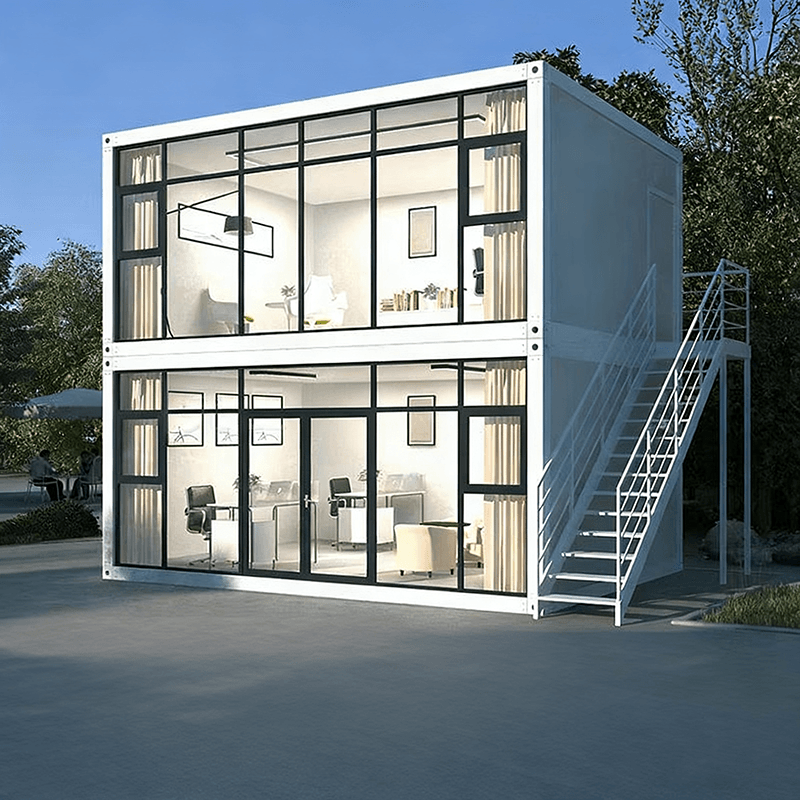
Structural stability is the fundamental safety guarantee. Choose products that meet national earthquake and wind resistance standards. For example, container houses with a full steel structure frame and automatic welding process can have frame deformation controlled within 2mm under a 12-level strong wind, far below the national standard limit of 10mm. Avoid non-standard products made of thin steel, which may only have a wind resistance rating of 6-7 levels, posing safety risks.
Installation efficiency directly affects project progress. Prefabricated products from leading manufacturers can be quickly assembled by a single person. For example, a hydraulic automatic unfolding structure can complete the unfolding of a single unit in 5 minutes, while manually assembled products take more than 10 minutes. For engineering camps or event support scenarios with tight schedules, efficiency differences may impact the overall delivery timeline.
Transportation and storage costs need to be evaluated in combination with usage scenarios. The folding ratio of foldable containers is a key indicator. Products from leading companies can have a volume after folding that is 1/5 of the expanded state, allowing a single truck to carry 20 units. The transportation cost per unit is 25%-30% lower than that of non-standard products. In terms of storage, high-quality products can store 80 units in a 100㎡ warehouse, showing significant long-term space cost advantages.
Reusability determines the full life cycle cost. Compliant products can be disassembled and reused an average of more than 8 times, reducing construction waste emissions by 90%. Products from leading manufacturers show no significant decrease in structural stability after 15 disassemblies and reassemblies, with the cost per use being only 1/3 of that of a new product. Non-standard products may experience frame looseness after 2-3 disassemblies and reassemblies.
Compliance is the core threshold for overseas projects. Exported products need to have international certifications such as CE and ISO, with a fire resistance rating of at least B1. New regulations in 2025 require modular buildings to have a reusability rate of more than 80%. Non-standard products may face customs seizure risks due to non-recyclable materials.
Customization capabilities adapt to diverse scenarios. High-quality products support the customization of special structures such as curved walls and floor-to-ceiling glass windows, with an internal space utilization rate of more than 90%. Design and production can be completed in 7 days, meeting the timeliness requirements of commercial pop-up stores.



