
New Style Container House
The new-style container house is a mobile, modular building form based on standard containers, achieved through structural modification and functional optimization. It features flexible adaptability, controllable costs, environmental protection, and high efficiency, and is widely used in temporary office spaces, accommodations, event support facilities, and other scenarios.
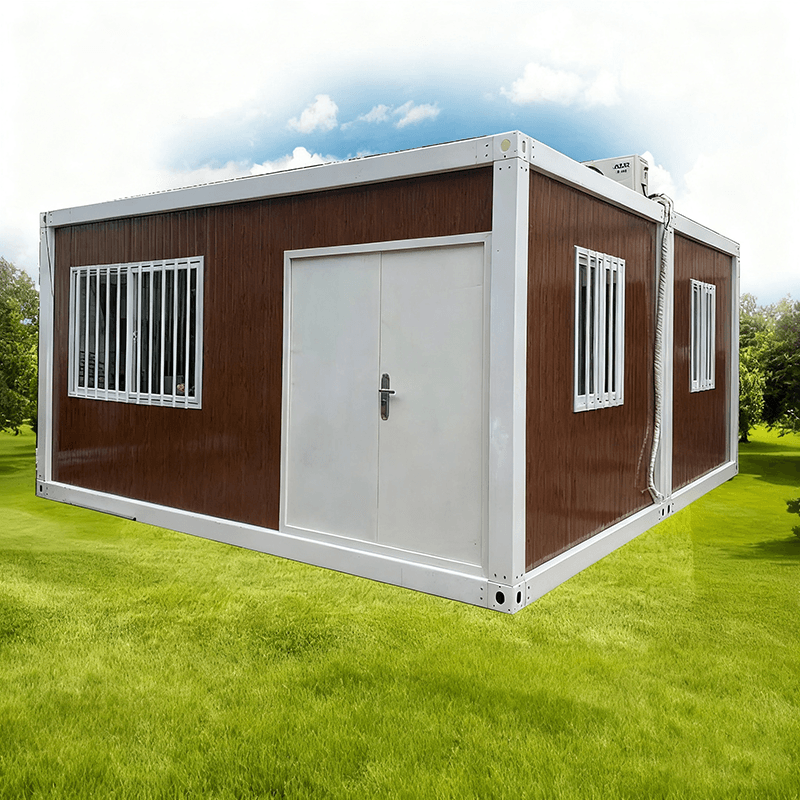
1. Structural Performance and Safety
The new-style container house employs a high-strength steel frame, such as a fully steel structure or a semi-welded, semi-bolted connection structure, ensuring overall stability. Extreme condition tests show that high-quality products can withstand wind speeds of up to 12 levels and seismic activity of up to 8 levels, with a frame deformation rate below 0.3% (the national standard threshold), significantly outperforming non-standard, off-brand products (which typically have deformation rates exceeding 1.2%). For example, the packing boxes from Suzhou Zhongnan exhibited a deformation rate of only 0.18% under 12-level typhoon conditions, while the ordinary container houses from Tianjin Yufada showed a deformation rate of 0.41% under 9-level wind conditions, posing safety risks. Additionally, compliant products must pass fire resistance tests (B1 level or above), effectively delaying the spread of fire and ensuring personnel safety.
2. Installation Efficiency and Scenario Adaptability
The new-style container house significantly shortens on-site installation time through prefabricated design. The installation time for a single unit ranges from 2 hours (for Suzhou Zhongnan's quick-assembly boxes) to 5 hours (for Tianjin Yufada's ordinary boxes), and supports splicing combinations and layout adjustments. For example, Suzhou Zhongnan's 'factory prefabrication + on-site quick assembly' model can deliver 1,000 accommodation modules within 3 months, reducing the industry average construction period by 40%. In contrast, off-brand products, due to non-standard installation processes, may take over 8 hours per unit, leading to project delays and fines amounting to 2.1% of the procurement cost.
3. Environmental Protection and Cost-Effectiveness
Container houses utilize recyclable materials (such as steel and rock wool sandwich panels), with a material recovery rate exceeding 80% after disassembly, reducing construction waste. Their transportation efficiency is significantly higher than that of traditional buildings, with foldable products increasing single-trip transportation capacity by 60% and reducing cost per kilometer by 25%. Over long-term use, the lifting and transportation cost per trip is approximately 15-25 yuan per kilometer, and there is no need for repeated renovations, resulting in low relocation and resettlement costs. For example, the Nagoya Asian Games adopted container houses instead of traditional athlete villages, significantly reducing expenses.
4. Functional Optimization and Innovative Design
To enhance living comfort, the new-style container house adopts a three-layer structure (outer galvanized sheet, intermediate rock wool insulation layer, and inner PVC-coated steel sheet), reducing indoor temperature fluctuations by 40% compared to traditional color steel plate houses, and lowering the cold-bridge effect through a thermal-break lining structure. In terms of spatial design, functional overlapping strategies (such as wall-mounted folding tables and drop-down beds) enable day-night functional switching, improving space utilization. Additionally, some products integrate self-circulating sewage systems, supporting use in wild environments without water and electricity.



