
Volver al blog
Artículo
Movable Integrated Housing Container
Admin 15 de septiembre de 2026
Movable integrated housing containers are independent office or living units formed by modifying standard containers as carriers, featuring sturdy structures, convenient transportation, and flexible combination and expansion capabilities.
I. Structural Types and Characteristics
- Standard Container Type: Based on 20-foot and 40-foot standard containers, independent spaces are created through internal modifications. With sturdy structures and strong wind and earthquake resistance, for example, products from Suzhou Zhongnan Steel Structure Co., Ltd. can withstand winds of up to 12 levels and earthquakes of up to 8 degrees on the seismic intensity scale. They are convenient for transportation and suitable for single-container use or multi-container assembly, commonly seen in project departments and construction site command centers.
- Folding Type: Adopting a folding structural design, the volume is compressed to 1/3 to 1/5 of the expanded state during transportation and can be quickly expanded upon arrival (with a single-set expansion time of ≤30 minutes). It reduces transportation costs by more than 40% and increases warehouse space utilization by 60%, suitable for frequent relocation needs such as exploration teams and temporary command posts.
- Expandable Type: By adding side or end expansion modules to containers, the usable area increases by 30%-50% after expansion. It balances structural stability and spatial comfort, suitable for long-term on-site office work or scenarios with high area requirements.
- Assembled Type: Combining light steel keels with color-coated steel plates, it is assembled on-site in a modular manner. It can be flexibly expanded according to the number of people and functional partitions, commonly seen in temporary offices in industrial parks and event planning sites.
- Customized Creative Type: Incorporating elements such as glass curtain walls, wood-grain finishes, and irregular structures, it balances functionality and visual expression, used in brand displays, cultural and creative parks, and high-end temporary offices.
II. Core Performance and Advantages
- Safety Protection: It has multiple attributes such as fire prevention, thermal insulation, heat insulation, waterproof sealing, wind resistance, earthquake resistance, and corrosion and rust prevention. For example, the frame deformation rate of all-steel structural frame container houses under a 12-level typhoon is only 0.18%-0.3%, far below the industry threshold.
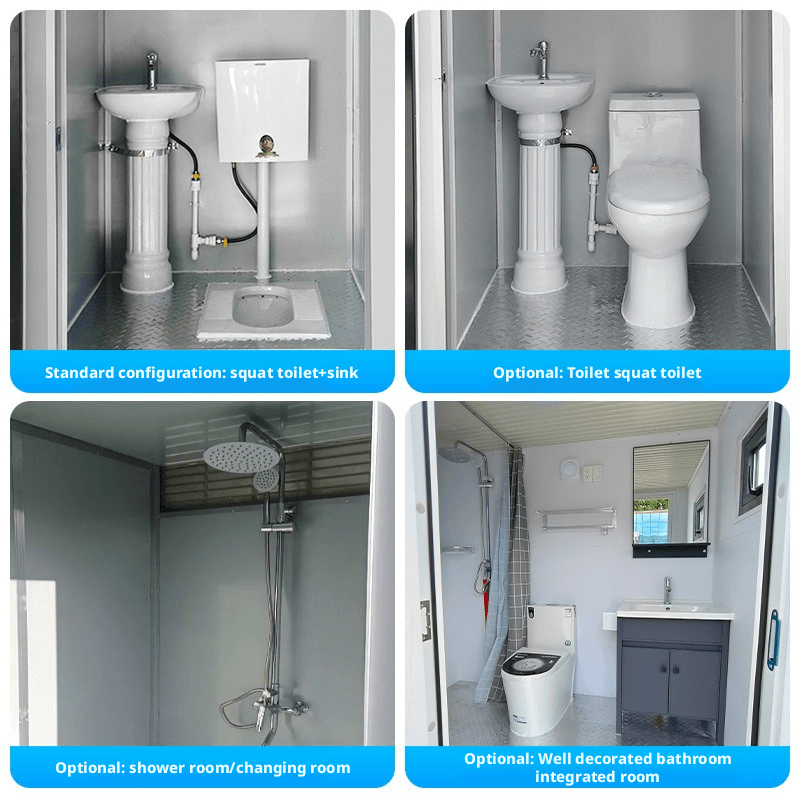
- Rapid Deployment: All structural, water and electricity, and sanitary components are pre-assembled in the factory and can be used after on-site hoisting and assembly, with deployment completed within 1 hour, without any wet work throughout the process.
- Economy: It supports multiple disassembly and reassembly cycles for reuse, with an average of more than 8 disassembly and reassembly cycles, reducing construction waste emissions by 90% and having a significantly higher resource utilization rate than traditional fixed temporary buildings.
- Flexible Combination: Different containers can be horizontally assembled or stacked in multiple layers, freely combined into office areas, dormitory areas, reception areas, etc., suitable for diverse scenarios such as engineering camps, mobile commerce, and cultural and tourism accommodations.
Relacionados



